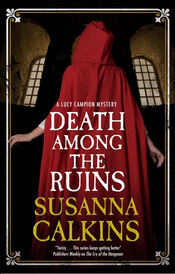
 Who would believe that my seventh Lucy Campion historical mystery and my ninth published novel overall, would be dropping next week? Certainly, not me. As I've discussed on this blog before, it took me over ten years to write my first book--A MURDER AT ROSAMUND'S GATE, which came out in April 2013. I truly thought it would be the only novel I ever wrote, and I remember feeling so accomplished that I'd gotten past that 100-page mark. Then, when I received my contract, a two-book deal, I began to chronicle every step of my journey, with such breathless excitement. Copy edits! Change of title! Cover reveal! 100 Days! ARCs! Release Day! Not to mention I was just writing post after post for SO MANY BLOGS. Blog tours! Blog journeys! Blog quests! I'm glad I documented the progress of that first book so well--the start of my Lucy's journey--because now...I'm tired. Not tired of writing. I'm never tired of writing. Or seeing my book out in the world. But, blogging is hardly on my radar at all anymore. And in fact, when I finally decided I'd better post about my new book, I couldn't remember my password, the settings had changed, and worst of all, I made a dreadful discovery.... 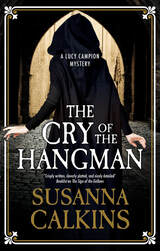 I NEVER POSTED ABOUT MY SIXTH LUCY NOVEL. THE CRY OF THE HANGMAN was published by Severn House in November 2021. And I never even told the story. Nothing about what inspired me, nothing about why I wanted to tell the story of a hangman, how I encountered a set of amazing objects that served as unexpected clues. I didn't talk about Lucy's relationships, after she stood at the crossroads. How is that possible? Seriously? Not one single post. That's awful. I mean, I feel I can reasonably blame exhaustion brought on by the pandemic and having a super demanding day job. I also managed to have two Lucy books out in one year too, which was just draining. And maybe blogs are just a decade out of date. (That's probably true). But a lot of awesome stuff happened in that book, and there's a part of me that feels I let Lucy down. So I've tried to re-inspire myself to find different ways to talk about Lucy in Death Among the Ruins. Who were these rag-sellers who roamed post-Fire London? How did the busk--a piece of a woman's corset--become a lover's token, and a key to a murderer's identity? These are the types of odd interesting details that drive me, and maybe just maybe, I'll write a post about it. Or not. But these Lucy Campion novels have been a true joy to write...they kept me sane when the world around me felt so difficult. And I'm so proud that I've been able to tell Lucy's story, and expand her so far beyond the 18-year old chambermaid who first opened the door to murder, plague, and London up in flames.
0 Comments
I went on to write two other mysteries, Murder Knocks Twice and The Fate of a Flapper set in 1929 Chicago, featuring Gina Ricci, a cocktail waitress in a Chicago speakeasy. (And some readers have asked me if Gina is Lucy's great-great-great-great-great granddaughter, and I always say, 'sure why not?' When the series is complete maybe I'll work out Gina's genealogy). I honestly thought that my time with Lucy and 17th century London would be over after DARF was published. But then Severn House approached me about writing another Lucy, and continuing the series, and I jumped at this amazing opportunity.
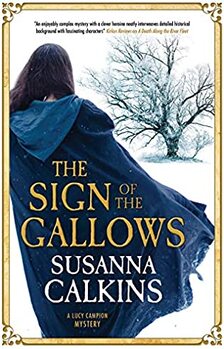
Getting back into Lucy's world was not nearly as difficult as I imagined. Essentially I just had to push my cocktail glasses off the table, stack my Prohibition books back on the shelf, and change my music from flappers fun to classical (I can't quite bring myself to listen to madrigals and baroque music, or drink mead for that matter, to get myself in the right mood). Each of my first four Lucy books all came to me in the form of an image, and The Sign of the Gallows was no exception. I immediately had the image of Lucy standing at a crossroads, because that's where I mentally pictured her (and me) to be. It can't get more "on the head" than that. This image was particularly appealing location for a mystery because in the 17th century a crossroads was still very much viewed as a dangerous and frightening place. Murderers and suicides were often buried at crossroads since they could not be buried in sacred grounds. The idea was that their tortured spirits would not be able to find their way back home and they'd get confused at a crossroads. That also meant, of course, that travelers needed to be wary, when passing through a crossroads, lest they attract one of these unfortunate souls and carry them back home with them.... That image gave way to a plot...Lucy discovers a dead man hanging from a gallows at the crossroads, drawing her into a puzzling mystery. The image of Lucy at the crossroads also informed Lucy's lot in life, and I wrote much of the novel with the idea that Lucy would be on a definite path by the story's close. However, ironically, just as I was writing the last chapter, I was asked by Severn House to write a sixth Lucy Campion mystery-- which meant I had to rethink Lucy's crossroads conundrum. A fun challenge to have! It's been so fun to jump back into Lucy's world. As I was writing, I did have this weird sense my characters had been waiting for me. A little like Pirandello's "Six Characters in Search of an Author," only the 17th century version. (Although that's a little disturbing, if you think about it too much). It's been really gratifying to be able to move Lucy's story forward, and to tell a story I never thought would be told. 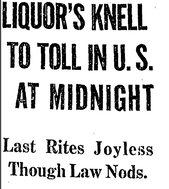 Chicago Daily Tribune Jan 16, 1920 Chicago Daily Tribune Jan 16, 1920 One hundred years ago, on January 17, 1920 at 12:01 AM, the United States collectively lost its mind. Well, perhaps less dramatically... the 18th Amendment officially went into effect across the United States and its territories, prohibiting "the manufacture, sale, or transportation of intoxicating liquors" for beverages purposes. And as we all know, this ill-fated act ushered in a wild era filled with cocktails, flappers, gangsters, and a whole mess of problems before it was repealed thirteen years later with the 21st Amendment. Of course, the actual 18th Amendment was completely lacking in clarity. The public raised many questions: "What constitutes an 'intoxicating liquor?'" "Will I be arrested for owning a case of 17th century bourbon?" "Can my grandmother still make herself some dandelion wine?" "What if I catch cold and only a hot toddy will cure me?" Burning questions indeed.  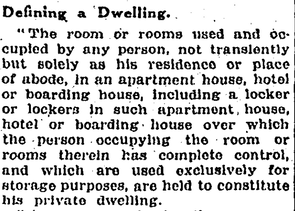 Chicago Daily Tribune January 17, 1919 Chicago Daily Tribune January 17, 1919 The National Prohibition Act (the Volstead Act) passed in 1919 sought to explain what was legal and what wasn't. Newspapers tried to break it down, and clearly everyone was trying to figure out the loopholes. Legally, you could: •Drink liquor in your own home or in the home of a friend when you are a guest. •Buy intoxicating liquor on a medical prescription of a doctor. (1 pint per 10 days) •Consider any place you live permanently as your home. If you have more than 1 home, you may keep a stock of liquor in each. •Keep liquor in any storage area if it’s for the exclusive use of your family or guests. •Get a permit to move liquor when you change your residence. •Manufacture, sell or transport liquor for non-beverage or sacramental purposes provided you obtain a Government permit. On the other hand you could not: •Carry a hip flask. •Give or receive a bottle of liquor as a gift. •Take liquor to hotels or restaurants and drink it in the public dining room. •Buy or sell formulas or recipes for homemade liquors. •Ship liquor for beverage use. •Store liquor in any place except your own home. •Manufacture anything above one half of one percent (liquor strength) in your home. •Display liquor signs or advertisements on your premises. 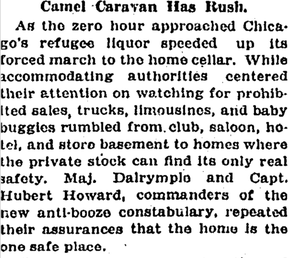 Chicago Daily Tribune January 16, 1920 Chicago Daily Tribune January 16, 1920 From reading the Chicago Daily Tribune, it was clear that the tensions between the "Drys" and "Wets" were highly visible during those first two weeks of January. The Wets were doing all they could to procure, sell and consume alcohol before time ran out, preparing for one last big bash before it all went away. The Drys, it seemed, were calmly waiting it out. You can also imagine them tapping their batons, ready to start dumping barrels and pulling over trucks as soon as the clock struck midnight. (Although the Tribune tells us the everyday Drys basically said, 'hey, there's no way we're starting in on this without a full night of sleep. We'll start messing with everyone after we eat breakfast at 8 am, so have at it this last night." While there was certainly a lot of terrible unintended consequences caused by Prohibition (ahem, rise of organized crime, massive gang violence, thousands of alcohol-related deaths, increased poverty for the have-nots), this was also a time of creativity and ingenuity in the manufacture, transportation and sale of illicit alcohol, the effects of which spilled over into art, music, fashion and song. Just imagine: Suits designed to hold hip flasks! New 'cocktail rings" to show off your wealth when you hold up your glass! Trucks built with false bottoms! Liquor-testing kits hidden in compacts to test your alcohol before you drink! (I mean, I'm sure that doesn't really balance at the bad effects...but it's definitely interesting to write about!)  By 1929, when my books are set, the effects of Prohibition--socially, culturally, economically etc--were well established (though not necessarily well-understood), and I try to bring in a lot of these tensions between Wets and Drys.
But on January 17, 1920, no one had any idea how everything was going to change...so cheers, I guess to at least the fun parts of this crazy venture! 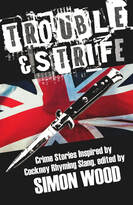 A year or so ago I was contacted by author Simon Wood about writing a short story for an anthology he was putting together. I think his pitch was something like, "Every story will be inspired by Cockney slang...you in?"
I was intrigued but really had no idea how Cockney slang worked, I just knew vaguely that it emerged in 19th century East London, but everything else I knew came from reading British mysteries. Luckily, Simon directed me to some Cockney rhyming slang dictionaries. I settled on Tea Leaf, which is Cockney for thief. It inspired me to write a story about a premise that always intrigued me--What would it be like to be caught in the middle of a robbery and suddenly realize that you know one of the thieves? What if you were then named as an accomplice? Like my other short stories, I took the opportunity to experiment with some new writing techniques. I find it fun to challenge myself (although writing a contemporary is already challenging for me). This is the first time I published anything in first person and in present tense. (I know, so incredibly innovative...) But it was challenging for me, and the prompt was so fun as a starting point I was delighted and honored to be included in Simon's anthology, which includes these amazing contributors
I've been crazy busy finishing up the edits for the second book in my Speakeasy Murders series, but I am proud that MURDER KNOCKS TWICE has been included in a few articles and podcasts. Check 'em out!   Fun interview with Lori Rader-Day and Layne Fargo, in which we discuss the different Chicagos in our books. Day job meets night job! Nice mention of the creative writing workshop I recently ran at Northwestern University Summer Writer's Conference in Pioneer Press.
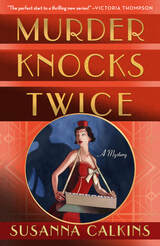 The launch of MURDER KNOCKS TWICE has been such a whirlwind! But I do enjoy meeting readers at my book events, and telling new stories about my research and writing.
I've also had the chance to write a few blog posts on different aspects of my research and writing. Here are a few:
 There's a funny thing about persistence that writers often talk about. We talk about continuing despite the odds, mustering up the courage to keep writing even when things get hard, just pushing on even when the outcome is not known.
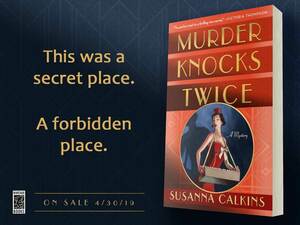
This is what I felt with MURDER KNOCKS TWICE, and how moving it has been for me to see this book out in the world. The journey of MURDER KNOCKS TWICE began about nine years ago. I was still querying--unsuccessfully--what would become the first novel in my new series--A MURDER AT ROSAMUND'S GATE. I kept getting rejected by agents, and I thought, 'Maybe I need to set aside this seventeenth-century novel, and try my hand at something different." (For the more complete journey of the first series, check out my post in HOW IT HAPPENED on the Thrill Begins). Even though I'm a British historian by training, for many years I've been teaching a graduate course on the History and Philosophy of Higher Education. On several occasions, I had found my way to the amazing archives at my university, and I began to think about setting my book on a college campus (much like mine) in 1930 Chicago. I was interested in college rituals and the role of the first women in college. I wrote about 200 pages of this book, which featured a young Egyptian woman named Shani, and her sidekick gum-cracking roommate Gina Ricci. I thought, this is going to be my new thing. My new historic period, my new world. But then, an interesting thing happened. That seventeenth-century novel ended up selling, and I ended up writing four books in that series (and will have a fifth out next year). So I set aside my 1930s Chicago novel, and it went in the DRAWER. But then, a few years ago, when my publisher asked me about a new series, I came back to that drawer and made an interesting discovery. The sidekick roommate was really the star of the book, and I moved her out of college, and into a West side Chicago speakeasy. Most of those 200 pages were scrapped, but the idea of the story remained. I wrote the first part without a contract, and then it was picked up. So there's a lesson in there, for me at least, about persisting even when the outcome is not known. The persistence was helped by loving the world that I was creating for my characters. I mean, speakeasies....cocktails....murder...? 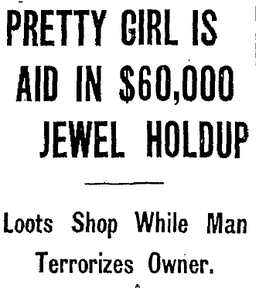 Chicago Daily Tribune (1923-1963); Dec 5, 1929; ProQuest Historical Newspapers: Chicago Tribune pg. 16 Chicago Daily Tribune (1923-1963); Dec 5, 1929; ProQuest Historical Newspapers: Chicago Tribune pg. 16 Every writer I know is regularly asked, "Where do you get your ideas?" Some authors love this question, some hate it. For me, I'm somewhere in between. With my very first novel, A MURDER AT ROSAMUND'S GATE, I was essentially answering a set of questions that had come to me while I was studying murder ballads as a graduate student (as one does!) So, back then, it was super easy and fun to answer. With my new series, the ideas came to me differently, so my response is no longer so pat. But I am regularly inspired by 1920s newspapers. 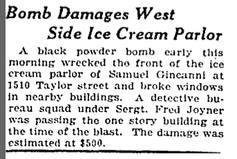 Chicago Daily Tribune (1923-1963); Sep 16, 1928; ProQuest Historical Newspapers: Chicago Tribune pg. 3 Chicago Daily Tribune (1923-1963); Sep 16, 1928; ProQuest Historical Newspapers: Chicago Tribune pg. 3 Obviously the newspaper is a great way to learn about what's going on in the neighborhood where I set my Chicago speakeasy, providing a useful level of detail. But more importantly, this kind of event can also be so inspiring--WHY would someone bomb an ice cream parlor? (Stay tuned--I answer that question in the second Speakeasy Murders) 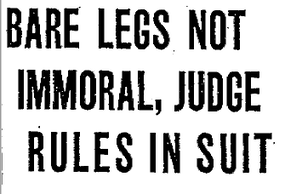 Chicago Daily Tribune (1923-1963); Oct 16, 1929; ProQuest Historical Newspapers: Chicago Tribune pg. 5 Chicago Daily Tribune (1923-1963); Oct 16, 1929; ProQuest Historical Newspapers: Chicago Tribune pg. 5 And of course, the headlines reveal other interesting things about Chicago culture. This kind of headline, "Bare legs not immoral," is exactly the kind of thing I will stop to read. It gives a lot of nuance to our understanding of the "New Woman," and this is the kind of detail that will find its way into my story. What inspires YOUR stories? Even if you don't view yourself as a writer, what inspires the stories you tell to others?
(Wow, that was unintentional cliffhanger! I thought I had published the actual content, but nope, I did not). So drumroll please....
...And the winning cocktail name is... .....the HOTSY TOTSY! Congrats to Kristopher Zygorski...the ARC of MURDER KNOCKS TWICE is on its way! Thanks very much to all who submitted cocktail names for my contest. I had an unofficial panel of judges, but asked my next door neighbor and former bartender Lisa McCaw to make the final selection. We all agreed it seemed fun, and captures the spirit of my book really well! Next up...figuring out the ingredients!!! 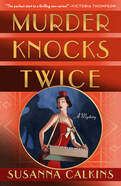 I'd love to have a signature cocktail--or at least a unique name slapped on an existing concoction--for upcoming book events. But I need your help! If you leave me an interesting and original name for my cocktail in the comments below, you could win my last ARC of MURDER KNOCKS TWICE. (And if you make it sound 1920s enough, the name could make it into my next book!) Here's the official blurb, if you need inspiration: The first mystery in Susanna Calkins’ captivating new series takes readers into the dark, dangerous, and glittering underworld of a 1920s Chicago speakeasy. Gina Ricci takes on a job as a cigarette girl to earn money for her ailing father―and to prove to herself that she can hold her own at Chicago’s most notorious speakeasy, the Third Door. She’s enchanted by the harsh, glamorous world she discovers: the sleek socialites sipping bootlegged cocktails, the rowdy ex-servicemen playing poker in a curtained back room, the flirtatious jazz pianist and the brooding photographer―all overseen by the club’s imposing owner, Signora Castallazzo. But the staff buzzes with whispers about Gina’s predecessor, who died under mysterious circumstances, and the photographer, Marty, warns her to be careful. When Marty is brutally murdered, with Gina as the only witness, she’s determined to track down his killer. What secrets did Marty capture on his camera―and who would do anything to destroy it? As Gina searches for answers, she’s pulled deeper into the shadowy truths hiding behind the Third Door. Thanks for your help! You're the Bee's Knees!!!! (but don't name your drink that--that name is taken! As is Corpse Reviver, Southside, Sidecar, Ward 8 (whatever that is)...
|
Susanna CalkinsHistorian. Mystery writer. Researcher. Teacher. Occasional blogger. Categories
All
Archives
May 2023
|
 RSS Feed