|
It seems like every day I receive a Google Alert, kindly informing me that another site has popped up, allowing my books to be downloaded for free. Not only are these parasitic companies stealing from me and other authors, but to add insult to injury, many users actually post comments on these sites, thanking these bottom-dwellers for the "service" they provide to readers. Sometimes these comments are so heartfelt it makes me wonder if the users don't realize they are committing an actual crime. Is that possible? Taking a step away from my indignant high horse for a moment, I do find it interesting that plagiarism and piracy of books has been around since the invention of the printing press. Initially, imitation in the Renaissance was seen as a compliment, a form of flattery, at least in art. In the world of the cheaply printed piece, necessity and practicality were at the heart of imitation. Printers regularly used the same woodcut again and again--say, of someone being hanged--most likely for ease of use and to evoke a certain image or memory in the audience. But over the next century or two, there seemed to be growing concern with the ability of printers to simply reset a piece and sell it for themselves. On occasion, advertisements to booksellers were created, informing them when a "sham" edition of a book had been created. They would implore the bookseller to consider the nature of property; they also seemed to speak to the bookseller's sense of quality, by reminding them of the inferiority of the sham piece. For example, this next advertisement reminds the bookseller that "The sham edition has several mistakes and blunders, contrary both to sense and grammar." 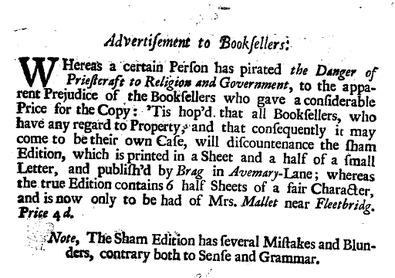 1702 E4:2[95] Some of these advertisements even specified that the printer, publishers and dealers would be prosecuted by the Company of Stationers, who as a royal guild had the sole power to oversee the publication of most written work, including almanacks as described in this next advertisement. In particular, I like the last line, which warns against those who would claim not to have known they were doing anything illicit: "This notice is given to prevent all persons from coming into trouble through ignorance." 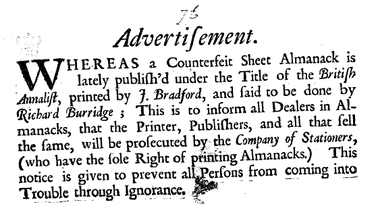 Lastly, I suspect this is where the practice of authors signing their own books came from--the author was attesting to the authenticity of his (or possibly, her) books. 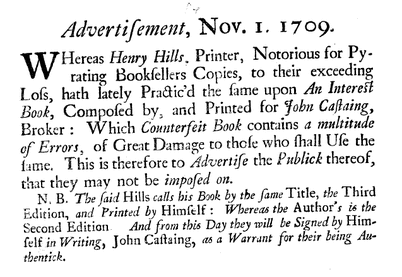 I don't know if its particularly heartening to realize that piracy and plagiarism are not a new phenomenon for authors. But it is interesting to think that such acts had long been condemned by the publishing community, even if the problem is still present 200 years later.
In my next post, I will tell you what happened to one of these plagiarists...
3 Comments
Guest Post in Writer's Digest: Balancing authenticity and accuracy while writing historical fiction9/8/2013 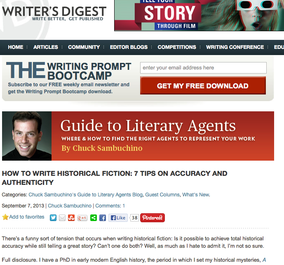 My post in WD appeared Sept 6, 2013 My post in WD appeared Sept 6, 2013 A few years ago, when I was first trying to figure out how to get my debut novel A Murder at Rosamund's Gate published, I came across Writer's Digest.
Full of advice for the fledgling writer and published author alike, Writer's Digest gave me some great insights into what I needed to do to polish my manuscript and write a compelling cover letter. (I mean, tell me it's not important to know "How to see your work through an agent or publisher's eyes?" or, "Knowing when to stop: Expectations for a satisfying ending.") So I really appreciated the opportunity to write a guest post, "How to write historical fiction: 7 tips on accuracy and authenticity" for Writer's Digest. In this post, I talk about the tensions I've experienced as a historian-turned-novelist, while writing historical fiction. I also try to offer a few strategies that have worked for me in reconciling these tensions. Check it out! And while you're there, try out the daily writing prompt! Although I have to giggle, because today the prompt is: "You are a local news reporter for a failing network. Your boss tells you to ramp up the news by getting “creative” and constructing your own stories. What’s the first fake news story you create and broadcast on air?" Fake News! Totally fun! Accuracy Shmackeracy! If you do take up the challenge, will you post it here too? I'd love to see it! 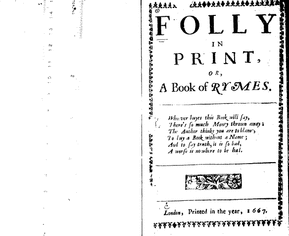 Folly in Print, (London, 1667) Wing / 436:03 Folly in Print, (London, 1667) Wing / 436:03 I had to laugh when I came across this tract by John Raymond, 17th century author of Folly in Print, or A Book of Rymes (1667). Right away, on the first page, he lets the readers know it really isn't his fault if you don't like his book: "Whoever buyes this Book will say, Next, Raymond then explains to his readers that if they believe what the bookseller says (or sings, as was often the case), it's their own fault if they find they don't like the book after all. "... in Books, where for money or exchange, we take our choice, and in our own Election please our selves; Can you imagine if authors could still add this type of caveat emptor today? Madness! But I'm sure there are many authors today--especially those stung by hurtful reviews--who might wish they could say something like this to their readers: I doe not promise for my Book nor say 'tis good, but here's variety and each man (of his own pallat) is the certain judge: You might like my book, you might not. To each her own!
But what do you think? Have you ever felt deceived about a book?  Intrigued?
Then check out my most recent post on A Bloody Good Read: Where Writers and Readers of Historical Thrillers Talk Shop  Today, I read an interesting article in the Chicago Tribune by John Warner--"The sting of a bad end." In it, Warner draws on the work by psychologist and Nobel Prize-winner Daniel Kahneman to probe the pain we feel as readers when a book (or worse, a series) we love ends badly.
Paraphrasing Kahneman's theory, Warner writes "...we have 'two selves': our 'experiencing' self and our 'remembering' self. Our experiencing self is just that, the part of us that's present while something is occurring. In Kahneman's formulation, that's the one who would answer the question, 'How are you liking the book?' Our remembering self is the one who answers "How did you like the book?'" Apparently, our memory of an experience is tempered by our perception of how the experience ends. So we could love every moment of a book, but if we don't like the ending, then we forget we enjoyed reading the rest of the book. (This is all part of a complex decision-making process--take this fun quiz to learn more about how you make decisions!) As a reader, I can relate to this feeling of intense disappointment when a book doesn't end as I had hoped. A beautifully wrought story should end, well, beautifully. And if doesn't? Well, there's a strong chance I won't read it again (and I'm someone who rereads books frequently). (Of course, maybe I wasn't in the right moment in life to appreciate the ending, but that's another story.) Warner ends with a plea: "On behalf of authors everywhere, I'm hoping we can add a little perspective and ask everyone to tell their remembering selves to remember their experiencing self, because the truth is that writing a good and fully satisfying ending is really, really hard." I agree with this. Absolutely. Completely. But I think there's an answering plea from readers to writers. Don't rush the ending! Be true to your characters! Care about your readers! How about you? Do you judge a book by how it ends? 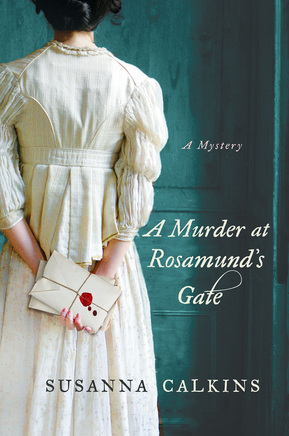 Some exciting news... A Murder at Rosamund's Gate is available for pre-order at Amazon and eventually where all books are sold.
Mark your calendars...the book will be released April 16, 2013. All-knowing Amazon also informs me of the specs:
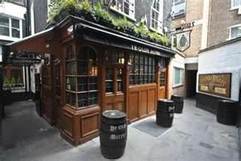 the murder may have happened here I had the opportunity the other day to contribute to a great blog, A Bloody Good Read: Where writers and readers of historical thrillers talk shop. There, I talked a little about a long ago murder and how a writer can fill in where historians fear to tread. Inspiration can be found in many places, I guess!  If you have a few minutes, check out the great entries by my colleagues: Nancy Bilyeau, author of The Crown (Touchstone, 2012) (she's also worked for all kinds of publications like Rolling Stone, In Style magazine, and Entertainment Weekly)...  ...and Sam Thomas, an early modern historian specializing in midwifery. Sam's first novel, A Midwife's Tale (Minotaur/St. Martin's) is due out in early 2013. 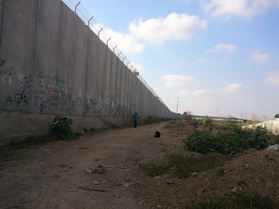 The wall through Qalquilya The wall through Qalquilya The first time I read Faulkner's As I Lay Dying I was fascinated by the fifteen or so perspectives on the same event: the death of Addie, the sickly matriarch of a poor Southern family.
There's a challenge, however, to acknowledging multiple perspectives of an event, to recognizing the value of competing narratives, even when multiple points of view can do much to advance a story. Recently, I've been thinking a lot about competing narratives, as I've traveled throughout Palestine and Israel as part of a higher education-related initiative I've been involved with through my "day" job. Last year, on my first trip to this highly-fraught region, my team was invited by several of our new colleagues--professors from a large Palestinian university-- to visit their communities. We found their families and neighbors to be warm, friendly--and extremely welcoming to strangers who could barely speak ten words of Arabic altogether. On one occasion, we visited Qalquilya, one of the communities divided by the Wall ("security fence"), and a town at the forefront of the troubles in the West Bank. Designed to separate the Palestinians in the West Bank from the rest of Israel, the Wall certainly now stands as a palpable symbol of the overwhelming distrust, fear, anger and sadness that has kept these peoples apart. Our colleague showed us around this town where she'd grown up, pointing out the small plot of land where her family still managed to grow vegetables. Under the hot sun, we sat beside the Wall, sipping mint lemonade, watching her neighbors shear sheep and her little niece kick a ball among the trash and compost. I remember this little girl asking me "What was it like, beyond the Wall?" As a Palestinian, she had no ready means for a visa that would allow her to see what was beyond the Wall for herself. Last week, on my follow-up visit, my group was able to take a trip to Haifa-- a city on the Mediterranean decidedly not within the West Bank. (The irony of being a foreigner--we could travel anywhere we wanted). Along the way, as we drove along the well-maintained Israeli highway, many tour buses passed us. I could see the tourists inside taking pictures of the Wall which, from our current vantage point, looked exactly like the walls you might see around a maximum security prison. I have no doubt the Wall looked scary and ominous. (Indeed, I met an American on the plane ride home who whispered to me how he had seen the Wall, with the air of someone who had braved something unimaginable.) The next moment, though, our tour guide mentioned that we had just passed Qalquilya--I was shocked. And profoundly disturbed. We could see the Wall, but nothing of the humanity within. Somewhere in there, my colleagues' little niece was playing. Or maybe she was staring at the Wall, still wondering who was out there, and why she was locked inside. I won't pretend to understand the complexities of Israeli-Palestinian relations. But clearly, there is more than one "true" narrative. I believe that writers of all types, whether of fiction or non-fiction, would do well to consider an event from more than one perspective. Few writers wield Faulkner's skill of course, to imagine the same event from 15 separate angles. And I'm not sure I've been brave enough to try. But questioning what is known, questioning one's beliefs, and seeking different takes on a subject, is crucial--for writers, and certainly for critically-thinking human beings. What do you think? Have you seen instances where using multiple perspectives has worked well? How? 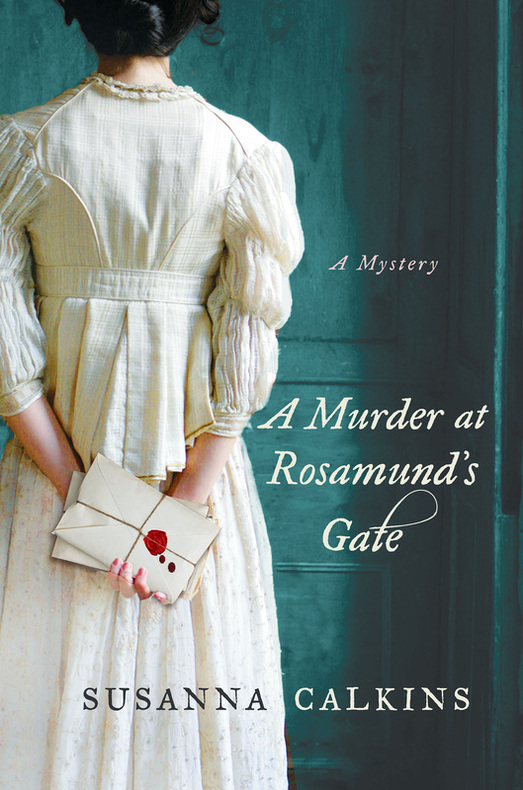 I can't tell you how excited I am to see the cover of my first novel!!!
A Murder at Rosamund's Gate. I think the artists at Minotaur captured the essence of my story beautifully. The opening (and closing) images of my novel are of Lucy standing at a door. There are some other clues about the story tucked away here, but you'll have to read the book to discover them for yourselves!!! 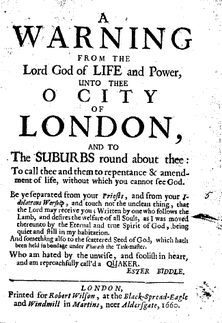 Esther Biddle, Quaker, 1660 This weekend I had the fun of seeing my first guest blog "Prophecy and Polemic— The Earliest Quaker Women" posted on the English Historical Fiction Authors website.
There, I discuss why Quaker women were so political and how they differed in one particular way from most other women at the time--even members of other non-conformist sects (such as the Diggers, the Ranters, the Levelers etc). And oh! how they expressed themselves... Dressing in sack-cloth "Running naked as a sign" Refusing to bow to authority But that wasn't all... Quaker women were different because they wrote. And they wrote. And they wrote. And they wrote. In fact, as a group, Quaker women wrote 220 tracts before 1700, more than any other women. Petitions, broad-sides, chapbooks--all carrying admonitions to King, Parliament and clergy to recognize sinful acts, accounts of injustices and cruelties to their members, and pleas to release their religious brethren from prisons and authorize non-conformist worship in England, and the American colonies. I've always respected the bravery and creativity shown by the earliest Quakers, in their attempt to get their message heard. I've often thought how hard that must have been for them to write these open pieces. They were not just challenging Parliament, Magistrates, Churchmen and the King: they were challenging convention and the very heart of patriarchy, often risking public ridicule, shaming, abuses and imprisonment. Taking the mantles of Old Testament prophets, mid-seventeenth century Quaker women wrote openly about the social wrongs they perceived around them, especially those caused by the (imagined and real) abuses of men in power. In the soul-examining spirit of the time, Quaker women--like their male counterparts--also wrote publicly about their own struggles to find the "Inner Light" and to give up earthly fripperies. (Poor Susannah Whitrowe--she really wanted to cling to her ribbons, but knew she wasn't supposed to) They wrote about death and heartbreak, joy and promise. (This is not too suggest that they did not use their expressions of suffering to advance their cause--both politically and religiously--but there is an honesty to their expression that is admirable). At a time when women who wrote were disparaged as "petticoat authors," early Quaker women persevered to make their voices known. Just as they "ran naked as a sign" to convey their discontent to religious and secular authorities, they wrote nakedly too. They laid their emotions and concerns bare, for public consumption, expressing themselves in ways that were both daunting and inspiring. As I writer, I certainly struggle to lay my words bare on the page. Those little editorial voices are hard to muffle! I'm hoping, with time, to find my most authentic voice. How about you? |
Susanna CalkinsHistorian. Mystery writer. Researcher. Teacher. Occasional blogger. Categories
All
Archives
May 2023
|
 RSS Feed