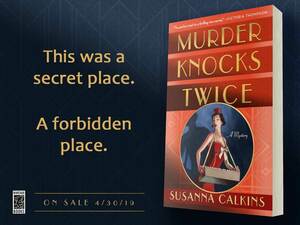
 There's a funny thing about persistence that writers often talk about. We talk about continuing despite the odds, mustering up the courage to keep writing even when things get hard, just pushing on even when the outcome is not known.
This is what I felt with MURDER KNOCKS TWICE, and how moving it has been for me to see this book out in the world. The journey of MURDER KNOCKS TWICE began about nine years ago. I was still querying--unsuccessfully--what would become the first novel in my new series--A MURDER AT ROSAMUND'S GATE. I kept getting rejected by agents, and I thought, 'Maybe I need to set aside this seventeenth-century novel, and try my hand at something different." (For the more complete journey of the first series, check out my post in HOW IT HAPPENED on the Thrill Begins). Even though I'm a British historian by training, for many years I've been teaching a graduate course on the History and Philosophy of Higher Education. On several occasions, I had found my way to the amazing archives at my university, and I began to think about setting my book on a college campus (much like mine) in 1930 Chicago. I was interested in college rituals and the role of the first women in college. I wrote about 200 pages of this book, which featured a young Egyptian woman named Shani, and her sidekick gum-cracking roommate Gina Ricci. I thought, this is going to be my new thing. My new historic period, my new world. But then, an interesting thing happened. That seventeenth-century novel ended up selling, and I ended up writing four books in that series (and will have a fifth out next year). So I set aside my 1930s Chicago novel, and it went in the DRAWER. But then, a few years ago, when my publisher asked me about a new series, I came back to that drawer and made an interesting discovery. The sidekick roommate was really the star of the book, and I moved her out of college, and into a West side Chicago speakeasy. Most of those 200 pages were scrapped, but the idea of the story remained. I wrote the first part without a contract, and then it was picked up. So there's a lesson in there, for me at least, about persisting even when the outcome is not known. The persistence was helped by loving the world that I was creating for my characters. I mean, speakeasies....cocktails....murder...?
4 Comments
 Probably one of the most frequently asked questions I get from people seeking to write historical fiction is this: How much research should I include in my historical novel? And my reply, which may sound more flippant than I intend, is just this: Enough to tell the story. I've written elsewhere about balancing historical accuracy and authenticity. So, I thought today I'd given an example of how I seek to have my characters interact with historical details, hopefully without just dumping my research on my readers. I could have picked any passage, but in honor of Easter, I picked an excerpt from my forthcoming novel, A DEATH ALONG THE RIVER FLEET. In this, scene Master Aubrey has just returned from selling pamphlets (unsuccessfully) on Maundy Thursday, (known in other parts of the world as "Holy Thursday.") There were a couple of factual details about Easter that I wanted to bring up in the scene. First, since the Middle Ages, there was a tradition in England that on Maundy Thursday, the monarch would give money to the poor and wash the feet of twelve poor people. [Indeed, while the etymology is not certain, the word "Maundy" may have come from the Latin world mendicare ("to beg.")] But we know from the diarist Samuel Pepys, in 1667, King Charles II opted against the practice that year, asking the Bishop of London to do it for him. Second, there had been an ongoing debate about the moveable date of Easter--some scholars of the time insisted that the date should be the same each year, similar to how Christmas was always on December 25. Third, in general, I wanted to allude to the fact that England was on a different calendar (the Julian Calendar) than Catholic nations like France and Italy, which had adopted the calendar created by Pope Gregory (the Gregorian Calendar). I couldn't use all the research I had at my fingertips, but I tried to work in a few of the more salient points within their trade as the printers and sellers of books. So you can see what details I managed to include... 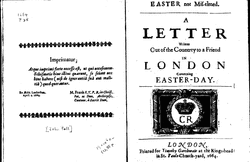 John Pell, Easter not mis-timed (1664) Wing / 395:11 John Pell, Easter not mis-timed (1664) Wing / 395:11 Master Aubrey laid his pack down. “I sold a few. I went to Whitehall to see the King wash the feet of the poor people, but the Bishop of London did it on his behalf.” The printer seemed a bit disgruntled. It had long been the custom for the monarchs of England to wash the feet of twelve men and women, as Jesus had washed the feet of the Apostles before the Last Supper. Having the Bishop of London take on the task instead of the king clearly irked him. Sometimes Lucy suspected the printer had Leveller sensibilities and liked it when the royals took on more mundane responsibilities. “Which pieces did you bring?” Lucy asked, changing the subject. In truth, she was always intrigued to know how the packs got decided. Master Aubrey had a knack for knowing what to sell to attract a crowd that she desperately hoped to learn for herself one day. “Could not very well sell murder ballads and monstrous births on Maundy Thursday, hey? Brought along John Booker’s Tractatus paschalis and John Pell’s Easter Not Mis-Timed. Too many of them, it seems. Only the sinners’ journeys, like the one you wrote about that Quaker, sold today.” He kicked the still-full bag, looking in that moment a bit like Lach, causing Lucy to hide a smile. A rare miss for Master Aubrey. Most people did not care how the date of the moveable holy day was affixed in the almanacs each year. Nor did they care why Catholic nations celebrated Easter and Christmas on different days than they did in England. I'm sure some readers might think that I have provided too much detail here, and other people think I have not offered enough. But, for me, this was "enough to tell the story."
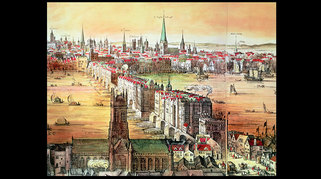 what bad event might have happened here? what bad event might have happened here? Since my first novel, A Murder at Rosamund’s Gate, was published in 2013, I have gotten many questions about my writing process. “Are you a plotter or a pantser?” is the question I most often get. Back then, I didn’t even know what the question meant. Now I know the questioner wants to know whether I outline my books in elaborate detail before I start writing (plotting), or do I go by the seat of my pants (pantsing), figuring out the plot and details as I go. I want to say that I’m usually captivated by an opening image—and that’s what my story revolves around. For my first novel, I have a young woman walking innocently up to a man she knows, who then surprises her by sticking a knife in her gut. Who was this woman? Why did she trust this man? And of course, why did he kill her? (Ironically, the image that inspired A Murder at Rosamund’s Gate never even made it into the final version. I had written it as a prologue, but I worried about starting the story twice. You can check it out here, if you are interested.). However, I've now learned that some things truly need to be figured out before I start writing the book. As I start my fourth Lucy Campion novel, I thought I'd try to share something of my process of thinking through the plot. I have my opening image, and--for now--a one paragraph description of the plot: When the niece of one of Master Hargrave’s high-ranking friends is found on London Bridge, huddled near a pool of blood, traumatized and unable to speak, Lucy Campion, printer’s apprentice, is enlisted to serve temporarily as the young woman’s companion. As she recovers over the month of April 1667, the woman begins—with Lucy’s help—to reconstruct a terrible event that occurred on the bridge. When the woman is attacked while in her care, Lucy becomes unwillingly privy to a plot with far-reaching political implications. So I have my opening image, but now I have to start thinking through all the big questions. Initially, I seem to do this as a reader. Who is this woman? What happened to her? What was this terrible event? Was it something that she witnessed, or is she physically injured. Whose blood is it? Why is she on London Bridge alone?
Then I will start the hard part--thinking through these questions as a writer. I've definitely learned that I need to figure out who the antagonist is from the outset. My natural tendency is to reveal the story to myself (pantsing), probably because I'm naturally more interested in how terrible events affect a community, not why people do terrible things. However, that approach usually means I don't know whodunnit, and that's a challenge for a mystery writer! I usually have to do a lot of backtracking and rethinking motivations and actions, when I have not worked out who the killer is upfront. So then, my next set of questions will be plot-related. What is this terrible event that occurred? Why did it happen? Who caused it to happen? How did this young noblewoman get involved in such a thing? And--sadly enough--I need to figure out if the London Bridge will work as a backdrop. I know it got burnt in the Great Fire, but I'm not sure yet how feasible it is that she ends up there. Then, because Lucy needs to be brought in, I need to figure out what makes this so urgent. Will this woman be attacked under Lucy's care? Probably. Why? What does she know? What are the larger implications of this crime. So, over the next week or so, I will brainstorm these big questions, and from there--voila!--a plot of sorts will emerge for me. I will figure out anchor points, motivations, and subplots from there. Then I will start writing. Every time I hit a roadblock, I will just start the questioning process again, until I figure out the direction I need to take to move forward. So I will call my approach, Plot-Pantsing. What about you? If you are a writer, what approach do you prefer? As a reader, do you think you can tell which approach a writer took? Murder, Mayhem and a Midwife...An interview with historian Sam Thomas, author of The Midwife's Tale1/8/2013 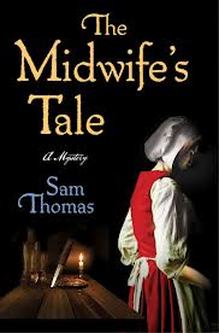 I'm excited to have historian Sam Thomas join me today to discuss his first novel, The Midwife's Tale, a historical mystery set in mid-seventeenth century York. Sam and I connected about a year ago, when we realized that (1) we're both trained as early modern English historians; (2) we both have debut novels coming out with Minotaur Books this year; and (3) both our mysteries are set in nearly the same time period. (I'm encouraging Sam to think about doing a cross-over piece, so that his midwife can bring my Lucy Campion into the world. But I digress.) -------------------------------------------------------------------------------------------------------- The Official Description: It is 1644, and Parliament’s armies have risen against the King and laid siege to the city of York. Even as the city suffers at the rebels’ hands, midwife Bridget Hodgson becomes embroiled in a different sort of rebellion. One of Bridget’s friends, Esther Cooper, has been convicted of murdering her husband and sentenced to be burnt alive. Convinced that her friend is innocent, Bridget sets out to find the real killer. Bridget joins forces with Martha Hawkins, a servant who’s far more skilled with a knife than any respectable woman ought to be. To save Esther from the stake, they must dodge rebel artillery, confront a murderous figure from Martha’s past, and capture a brutal killer who will stop at nothing to cover his tracks. The investigation takes Bridget and Martha from the homes of the city’s most powerful families to the alleyways of its poorest neighborhoods. As they delve into the life of Esther’s murdered husband, they discover that his ostentatious Puritanism hid a deeply sinister secret life, and that far too often tyranny and treason go hand in hand. -------------------------------------------------------------------------------------------------------- 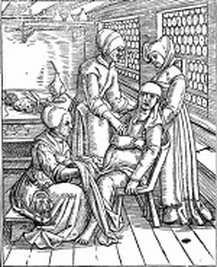 A midwife at work The Midwife's Tale is told through the first person perspective of Lady Bridget Hodgson, a 30-year old twice-widowed midwife and real historical figure. How much is known of the true Bridget, and how much of her personality/character did you invent? Did you ever feel constrained writing a fictionalized account of a real person? That’s a great question! We know a fair bit about Bridget, and I include some of it here. A lot of the basics are true: She was twice widowed, first to a man named Luke Thurgood, then to Phineas Hodgson, who was the son of the Lord Mayor of the York. (And yes, Phineas seems to have been every bit the loser I portray him as.) Bridget also had a deputy named Martha, though I had to invent much more of her background. It is also pretty clear that she was a very strong woman. She came from an ancient family and wanted people to know it. She also named all of her goddaughters (as well as her own daughter) ‘Bridget’, presumably after herself. Who does that? I did, however, make some cuts. For my first book I had a heck of a time writing her home life, so I made her childless, though the historical Bridget was survived by two daughters. There are also rumors that she had two sons, both of whom were hanged as highwaymen, which is amazing, but I’m not sure I believe it. 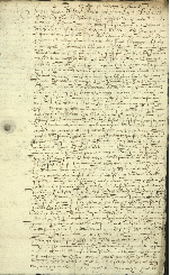 Bridget's Will Similarly, is the case at the heart of The Midwife's Tale based on a true case from the archives? How did you go about doing your research?
The case itself is entirely fictional, though a lot of the supporting characters are real. As for the research it was a lot of digging. I stumbled across Bridget’s will when I was working on another project, and it provided dozens of names for me to chase down: friends, family, and best of all, godchildren, which allowed me to identify a handful of clients. Once you have names, you can then dig into baptismal registers, tax records, probate documents, legal records, histories of York…it’s endless, really. I also got very lucky that Bridget was once sued for defamation, which allowed me do dig even further into her social life and the history of her practice. Besides being a compelling read, your story gets at some of the larger historical themes around gender, politics and religion that shaped this time period. In what ways did you consciously try to illuminate these larger trends? How did you balance the need for historical accuracy with creative license? I consciously wanted to connect ‘big’ and ‘little’ history. The novel takes place in the midst of a rebellion against the king, so I made the crime at its heart a domestic rebellion in which a wife is accused of murdering her husband. This was a time when people were intensely concerned about maintaining order at the national and domestic levels, and I wanted to see how they would react when that order was challenged. (Oddly – or not – I do much the same thing in my historical work, favoring microhisotry, in which big stories are told through the lives of average individuals.) In doing your research, what was one of the most interesting things you learned? I think it was how complicated life as a midwife could be. Not only did they deliver children, they were part of the legal system, investigating crimes ranging from infanticide, to rape, to witchcraft. It really makes midwives the perfect sleuths!  the codes in the fire poems... There's been sort of a funny game of tag going among writers recently, called "The Next Big Thing." So crime fiction writer Holly West was kind enough to tag me, which means it's my turn to answer some writerly questions and tag some other writers. 1) What is the working title of your next book? After A Murder at Rosamund's Gate releases April 23, 2013 (sigh, yes, I'm still awaiting this great moment), my next book featuring Lucy Campion is From the Charred Remains. That's still my working title at the moment, although I will probably change it when the book gets closer to publication (in 2014). 2) Where did the idea come from? FTCR continues two weeks after A Murder at Rosamund's Gate leaves off; that is, directly after the Great Fire of London in 1666. So many people, including Lucy, were pressed into service to assist in the great clean-up after the Fire. I thought for sure secrets would have to emerge from charred remains. Of course, plucky Lucy has to be the one to encounter an intriguing puzzle.... 3) What genre does your book fall under? FTCR is a mystery, and within that historical fiction and traditional. I'm not quite sure if readers at Danna's awesome cozy mystery blog would call it a cozy or not, but like Anne Perry's books, it has elements of a cozy.  4) What actors would you choose to play the part of your characters in a movie rendition? I don't want to give away my thinking completely (since I prefer readers to imagine characters for themselves) but I wouldn't be adverse to the compelling Michael Kitchen (Foyle's War) portraying my kindly magistrate. 5) What is the one-sentence synopsis of your book? Ack! The dreaded one-sentence synopsis. Torture to the writer! Here goes... Lucy Campion, a chambermaid turned printer's apprentice, discovers in the aftermath of the Great Fire the body of a murdered man; on his corpse, she finds a poem which she publishes, little realizing that this act would bring her once again into direct confrontation with a murderer. 6) Will your book be self-published or represented by an agency? I am represented by the amazing David Hale Smith of Inkwell Management. Both books will be released by Minotaur Books (St. Martin's Press). 7) How long did it take you to write the first draft? Given that A Murder at Rosamund's Gate took me about ten years to write (seriously!) I'm amazed to say that I wrote FTCR in just a few months. 8. What other books would you compare this story to within your genre? I've been inspired by both Anne Perry and Rhys Bowen. 9) Who or what inspired you to write this book? I've been inspired to write these stories ever since I was a doctoral student of history. My husband and kids inspire me every day to keep pursuing my dream... 10) What else about the book might pique the reader's interest? If you like puzzles and codes, this one is for you... On Dec. 19, please be sure to check out these awesome writer's blogs...
Anna Lee Huber, The Anatomist's Wife Helen Smith, Alison Wonderland  Intrigued?
Then check out my most recent post on A Bloody Good Read: Where Writers and Readers of Historical Thrillers Talk Shop  Interacting with Mars The other day a faculty member who teaches college science courses shared with me an innovative method he uses to enhance critical and creative thinking in his students.
Instead of having his students complete more traditional reports on scientific principles and concepts, he has them create science fiction stories, drawing on those same scientific ideas. (Boy would I have loved science if my professors had asked me to do that!). As we talked, we discussed the necessity of not just asking students to sprinkle scientific details through their stories, but rather the importance of having their characters engage with those details. This would add to the scientific authenticity. More importantly, I think they contribute to the overall richness of the story. So, for example, a writer could just passively describe Mars: "The floor of the Gale Crater was grayish-blue in color. Brown and gray pebbles were strewn everywhere. At the center of the crater was Mount Sharp. Without any sign of life, Larry thought it was definitely the perfect place to land the Motherland's craft." Or, the characters could actively engage with the Martian terrain--as they would engage with another character: "As Larry stepped cautiously down from his craft, his boot sunk a little deeper down into Gale Crater than he had expected. What he had thought would be thickly-layered bedrock was actually more sponge-like in its composition. This was not the first time the Motherland's Minister of Science had been wrong about a planet. He kicked one of the many brown pebbles strewn across the landscape. "It's going to take me forever to get to Mount Sharp," he muttered to himself. "Why'd the General tell me to land here? The mountain's at least three kilometers to the north." Shivering, he checked the temperature gauge on his suit. 66 degrees. "Geez, it's dropped at least 10 degrees since I landed." Out of the corner of his eye, he saw one of the pebbles move. "Uh, oh." He groaned. "That's no pebble!" Okay, there's a reason I don't write science fiction. But when I was first embarking on my novel-writing journey, I learned about the concept of treating description, scenery, weather, etc as another character. Details should be added to enhance the experience of a character. In A Murder at Rosamund's Gate, for example, I turned the ever-present London fog into a character--alternatively gentle and tempestuous in turns. Of course, this is a matter of taste. There are plenty of great books out there--especially some of my favorite nineteenth century novels--that have PAGES and PAGES of description without a bit of dialogue or action to break them up. But I admit, I probably skim long passages of description for the most part. How about you? Do you enjoy books with lots of scenic descriptions? Or do you prefer when characters engage with the scenery, as they would engage with another character?  who are these people anyway One of my favorite past-times is to imagine back stories for the people I see at coffee shops, parks, airports, you name it. I'm always speculating about their personal lives, the secrets they keep, their ambitions--either thwarted or realized.
I also like to imagine people in completely different historical contexts. I never make them actual known historical figures, but I might connect them with someone famous. For example, I often look at my eighteen-year old students as World War I soldiers, or the people sipping wine as Macedonians, or the woman strolling down the street as a Druid priestess (not really sure what that looks like though) or the person who cut me off a French aristocrat (sorry about your impending beheading...) One of my friends for sure would be a disguised Han warrior, making tea for her family, then sneaking off to fight the Huns. (Or am I thinking of Mulan?) Another friend would have been an early suffragette, and still another, a village chieftain. A professor I know would have been an Abbott, living a scholarly life in a monastery. And so on. I always imagine my husband as a Viking ship-maker or one of Charlemagne's armor-makers. I wouldn't have met him, unfortunately, as I'd have been a servant in some great English manor or maybe teaching in a one-room schoolhouse on the prairie. Or taking bribes as a Chicago gumshoe. Something like that. A girl can dream. It's fun to speculate what we might have been like 50, 100, 1000, 2000, 10000 years ago! (Cave-man anyone?) Or for that matter, if we lived 5000 years in the future. What about you? How would you imagine yourself in a different time period? 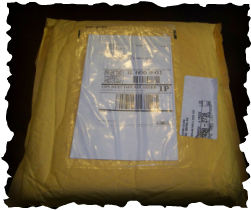 The other day, I experienced one of my odder moments as a writer. When I came home from work, I found a much anticipated package containing the page proofs for A Murder at Rosamund's Gate (that's not the odd part, that's the extremely thrilling part). 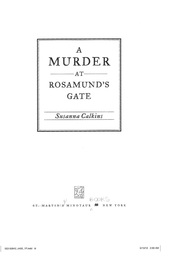 the inside cover page At this point, I can only make very minor edits. A word here and there, typos, minor grammatical changes--that's about it. The book is nearly ready--all 340 pages of it. A heady and strange mixture of emotions regularly accompany this realization.
But the odd thing? Later that same evening, I happened to be poking through some old files and I came across the very first handwritten draft of this novel, which I began in 2003. All scratched up, full of non sequiturs and dangling thoughts, somehow this mess became an actual novel. Holding that handwritten draft alongside my proofs was definitely a surreal moment, and it was hard not to compare the original version with the final. To be sure, some things were different. My heroine was originally named Abigail, although somewhere along the way, she became Lucy. Another main character saw his name changed several times too, from Thornton to William to Adam. I also had a prologue then (which I've since eliminated, as I've mentioned before), and even more interestingly--I had an entirely different adversary than the one who crept into the pages later. In fact, the main crime was different, although I had written emphatic notes to myself--'Must take place during seventeenth-century plague and Great Fire of London.' So the setting never changed, nor did my original inspiration. The book took me ten years to write. Honestly, I never thought when I began this story that I would even finish it, let alone that it would be out in the world. But the proof, I guess, is in the proofs. 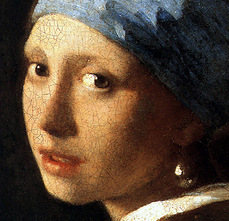 Did Scarlett J. do this character justice? After I viewed the trailer for Hunger Games, I admit I breathed a great sigh of relief. The young woman playing Katniss (Jennifer Lawrence) seemed spot on, as did the young man in the role of Gale (Liam Hemsworth). I have to say, too, that Peeta (Josh Hutcherson) looked better than what I imagined. The movie looked exciting, and more importantly, seemed true to this tense and unpredictable book.
Why was I worried, you might ask. Like every reader, I had imagined these vivid characters--and the whole world--in a certain way, bringing my own sensibilities and experience into the book. Sometimes, it's really hard when an actor seems all wrong for the character. (Case in point--I enjoyed Matthew Macfadyen in MI-5, but I think he really misunderstood Mr. Darcy in Pride and Prejudice--and not just because the wonderful Colin Firth had already dominated the role). I always wonder what it's like for authors to see how others view their characters. Perhaps sometimes the characters dance off the pages, just as they'd imagined, while at other times emerge as virtual strangers. For my part, I garner physical descriptions for my characters by seeking out visual cues. Sometimes I rely on period art, as I think Tracy Chevalier may have done with Vermeer's The Girl with a Pearl Earring, to get a feel for how someone in early modern England might dress or wear their hair, and to ponder their worldview. More often than not, I find photos of real actors to help me remember what each of my characters is "supposed to" look like, at least to me. Hmmm...I could share those photos and images, if I wanted to. I'm pretty sure, however, it's cheating when you tell readers how they are supposed to think. So as a writer, I'll stay hands-off about my own characters. I accept that characters are negotiated through the lenses that readers bring to the text. As a reader, I admit I often don't want that negotiation to happen. I want to see on the big screen exactly what I see in my mind's eye. Otherwise, I'm confused, even disappointed. Johnny Depp as Willy Wonka? George Clooney as Batman? Jim Carrey as the Grinch? I'm not so sure. But sometimes characters evolve from author to reader to viewer, when in deft hands. Consider Matt Damon as Jason Bourne. Robert Downey Jr. as Sherlock. Emily Deschanel as Temperance Brennan. And yes, Scarlett Johansson as Griet, the Girl with a Pearl Earring. None of these characters were really rendered as the author wrote them, and yet I was satisfied, even intrigued, in their re-imagining. The problem at that point, of course, is when everyone says: 'I think the characters were better in the movie than in the book." ARGHHHH! What do you think? Have you ever been surprised--pleasantly or unpleasantly--when a character is portrayed very differently than what you had imagined? |
Susanna CalkinsHistorian. Mystery writer. Researcher. Teacher. Occasional blogger. Categories
All
Archives
May 2023
|
 RSS Feed