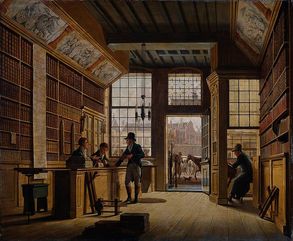
 Jelgerhuis, "Bookshop," (1820) Jelgerhuis, "Bookshop," (1820) I am always a sucker for book lists that ask things like: Have you read more than 6 books on this BBC book list? (I've read 47/100, which made me feel pretty good). Or, "How well-read are you?" (Gulp, just 40 out of 155). Or, how many of the 100 best-loved novels of all time have you read? (44, so a little better). And of course, How many of these top 101 crime novels have you read? (Just 18, ouch) And then I look at what the "experts" identify as the "best" 100 novels. The Modern Library's 100 best novels (I've read 18 of 100). One hundred best American Novels (1770-1985) (I've read 12 of 100). And, of course, responses to such lists (I've read 13 of 100). And lists that combine both such lists. (For the record, I've read 31 of 100). The lists are fun, but sometimes, puzzling. (Seriously, Ayn Rand? Not sure I'll ever see the attraction there). Mostly these lists just remind me of all the books I want to read, but haven't gotten around to it. So I thought I'd create a list of books I thought that I've wanted to read. See if any are on your to-be-read pile!
[update: I have actually crossed one off my list!] Books in the "Why am I waiting to read this?" category:
Books in the "This looks interesting, I'll read it if I remember it" category
Books in the "It MUST be good because everyone loves it but I couldn't get into it the first time I tried" category
Let me know how many of these you've read! (and since I need to prioritize, let me know which one I should read first!
1 Comment
 A while back, I was contacted about participating in a local author fair. Not only was I just personally delighted, given how much I love libraries and librarians, but I was just amazed when I saw who had extended this very kind invitation. The Joliet Public Library, Black Road Branch. In Joliet, Illinois. Now before I came to live outside Chicago, I grew up in Philadelphia. My father, however, had grown up in Joliet Illinois. His mother, my grandmother, worked at the main branch of the Joliet Public Library for thirty years, retiring shortly after I was born in 1971. In an interview published in the Joliet Herald-News dated December 26, 1971, my grandmother explained that she'd started as an apprentice at the library, working her first two and a half months without pay! Initially, she mainly shelved books, but was also called on to mend books as well: "There were no book binders at that time, so when books became damaged by usage and wear, we sewed them by hand. I learned how to build a book from the bottom up."-Josephine Calkins 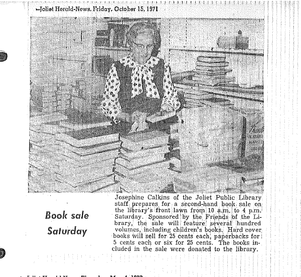 My grandmother, 2 weeks before I was born! My grandmother, 2 weeks before I was born! She left the library in 1936 to get married--my father says she met his father at the library! After taking coursework at the University of Illinois library school, she returned to the Joliet library in 1953, working in the children's, reference, and adult departments. From 1956 to 1965, my grandmother was in charge of the library's bookmobile, before becoming an assistant librarian. The experience at the bookmobile, she said, helped her learn about what people liked and disliked, which later informed her purchasing decisions. 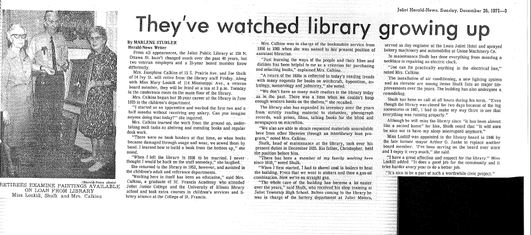 When asked to reflect, in December 1971, about what had changed since she first started working at the library, she had this to say: "A return of the 1930s is reflected in today's reading trends with many requests for books on witchcraft, hypnotism, astrology, numerology and palmistry....We don't have as many male readers in the library today as in the past. There was a time when we couldn't keep enough western books on the shelves...." I can only imagine what my grandmother would think of current library trends now. Back then, microfiche and microfilm collections as well as "The New InterLibrary Loan Program" were just starting to transform how library patrons could access materials. What would she think of the digital revolution?
Unfortunately, my grandmother passed away in 1987, so we can't know. From what I do remember, she had a deep and abiding love of books, which she passed on to my father and my siblings. I'd imagine she'd be thrilled at the ready access of books and the long reach that modern libraries can attain. (The other thing I remember about my grandmother was that she taught me to embroider, on one long visit to Philadelphia. While I appreciate that skill, I can't help but wish now she had also taught me how to build a book--a worthy skill indeed!) As I've mentioned before, I grew up in a house literally lined with books, many of them bequeathed to us from my grandmother. I truly believe that my love of writing stems from my love of reading, a trait inherited from both my parents (my mother was also a librarian). So I believe it will be quite a moment when I set up my table on Saturday. On one side, my first novel, A Murder at Rosamund's Gate. On the other side, the photos of my grandmother passing out books at the Joliet bookmobile. My parents are even making the trek out! I don't know what to expect exactly, but I'm sure it will be great! 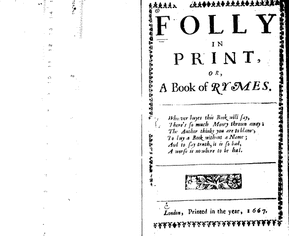 Folly in Print, (London, 1667) Wing / 436:03 Folly in Print, (London, 1667) Wing / 436:03 I had to laugh when I came across this tract by John Raymond, 17th century author of Folly in Print, or A Book of Rymes (1667). Right away, on the first page, he lets the readers know it really isn't his fault if you don't like his book: "Whoever buyes this Book will say, Next, Raymond then explains to his readers that if they believe what the bookseller says (or sings, as was often the case), it's their own fault if they find they don't like the book after all. "... in Books, where for money or exchange, we take our choice, and in our own Election please our selves; Can you imagine if authors could still add this type of caveat emptor today? Madness! But I'm sure there are many authors today--especially those stung by hurtful reviews--who might wish they could say something like this to their readers: I doe not promise for my Book nor say 'tis good, but here's variety and each man (of his own pallat) is the certain judge: You might like my book, you might not. To each her own!
But what do you think? Have you ever felt deceived about a book? 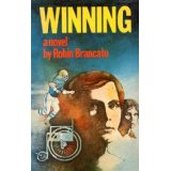 From time to time, I've thought to myself I'd like to find more sports-related books for my children.
Today I opened a care package from my mother. Inside, were the usual niceties she likes to send: activity books for the kids, some little notepads and stickers, some coupons and...a book. The book was called Winning. A Novel by Robin Brancato. This book looked familiar to me. I thought, 'Oh, my parents must have found one of my old books up in the attic, and decided to include it in the care package.' Well, yes and no. It was one of my old books. Inside, was the elaborate scrawl that I used to sign my books with, along with the date I had acquired it. April 9, 1988. In the corner someone had penciled $3.00, so it was clearly bought second-hand from my local Wynnefield Library book sale (remember, the most beautiful library in the world). I don't know why I had picked it up as a teenager, actually, since I never really liked sports-themed books. As it turned out, though, Winning is the story of a young football player whose life is turned upside down by tragedy, so not a typical sports story at all. Although I only read this one once, it was an extremely compelling read. But when I left home to go to graduate school in 1993, I remember giving away a bunch of my old books to a local Goodwill, a few towns away from my parent's house in Philadelphia. Winning was one of those books. In the note I received today, my mother wrote: "We found this book in the Overbrook Train Station Book Swap." The Overbrook train station is just a few blocks from my parent's home in Philadelphia. So, almost exactly TWENTY YEARS LATER, the book returned to my parents, and they returned it to me. Where has the book been for twenty years? I'll never know. I do know I will save it for my children to read--I don't think they would have ever read this amazing story otherwise. But maybe this is just a reminder that sometimes when you throw a question to the universe, you never know how you'll be answered...and perhaps that's the fun of it. What do you think? Have you ever tossed a question to the universe and seen it answered in strange ways? 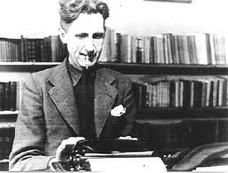 Two hands good, one typewriter bad In college, I took a really great class on George Orwell. While I enjoyed exploring his better known works (such as Animal Farm and 1984), I was fascinated by the essays that Orwell penned about different aspects of his life. In particular, Orwell's essay "Why I Write" resonated with me at a deep level. I read the piece again recently, and I'm still struck by his explanation of what motivated him as writer and--arguably--perhaps all writers. He says there are four main motives for writing:
These last two points do much to drive and inform my own historical novels. I don't believe in absolute truth, or in one set historical narrative. I do hope, however, to get readers to question their perceptions of society, culture, gender, power and privilege--to rethink what they think they know. While my agenda is wrapped up in what I hope is a compelling mystery, its certainly there. I'm curious though. Do you agree with Orwell? Are books by nature political, in the widest sense of the term? Harry Potter? Twilight? The Lord of the Rings?  I've been joined here today (virtually!) by a long-time reader of mysteries, Danna, who blogs at the wonderful Cozy Mystery List Blog.
I've been following Danna's blog for a while. As a reader it's an invaluable place to discover new-to-me mysteries. As a writer, I've gleaned some great insights from her readers about what they think works well and what doesn't in a mystery. So Danna has been gracious enough to share some of her thoughts here. Tell us a little about yourself--have you always been a big reader? I grew up in a military family. The longest time I lived in one location (four years) was when my father was stationed in Spain. Looking back, I guess I could say that the one "constant" (besides my family, of course!) were my books. They could travel with me and keep me company during the time it took to make new friends. I have my master's degree in education and have taught school in both middle and high schools. I thought for sure I would continue teaching school in Colorado, but I married a military man which meant going back to the nomadic life of my childhood. When did you start reading mysteries? I began reading mysteries when I started reading my sister's "hand-me-down" Nancy Drew and Hardy Boys mystery books. From there, I graduated to Edgar Allan Poe, Sir Arthur Conan Doyle, and "Victoria Holt-type" mystery books. (My grandmother's house was full of books, and her local library was a place she and I visited many times.) Is this your favorite genre? Obviously, with a site that has "Cozy Mystery" in its name, cozy mysteries are my favorite genre. However, I read police procedurals, true crime, and when I have time, non mystery themed books. (Non mystery author E. F. Benson is my all-time favorite author.) My husband's taste in books is much wider than mine, so he occasionally finds something he thinks I absolutely have got to read. ("The Hiding Place" by Corrie ten Boom is one of his recent "finds" - and I can't say enough good things about that book.) Why did you begin to blog about mysteries? Years ago I belonged to several online mystery reading groups. I made two very good mystery-reading friends in two of those groups. When I found that I needed a system for cataloging the books I read (buying the same books twice), I started making a list of all the mystery authors I read and liked and included authors who I didn't like - so I wouldn't end up buying their books ever again. When my friends found out about my systemized lists of authors and books, one of them asked if I would share it. I then began adding their favorite (and least favorite) authors to my list. From there, I started my site - with a lot of computer/technical help from my husband. I had been frustrated trying to expand my list of cozy mystery authors. At the time (2006) there weren't any internet sites that were devoted to cozy mysteries (at least not that I knew of). And then an unexpected thing happened: I started getting e-mail from people all over the world, asking for help in identifying authors, or for suggestions about what to read, etc. My husband saw that I spent quite a bit of time answering these letters, and suggested that I start a blog. He finally convinced me, and the response to my blog was an even bigger surprise to me!  Today, I read an interesting article in the Chicago Tribune by John Warner--"The sting of a bad end." In it, Warner draws on the work by psychologist and Nobel Prize-winner Daniel Kahneman to probe the pain we feel as readers when a book (or worse, a series) we love ends badly.
Paraphrasing Kahneman's theory, Warner writes "...we have 'two selves': our 'experiencing' self and our 'remembering' self. Our experiencing self is just that, the part of us that's present while something is occurring. In Kahneman's formulation, that's the one who would answer the question, 'How are you liking the book?' Our remembering self is the one who answers "How did you like the book?'" Apparently, our memory of an experience is tempered by our perception of how the experience ends. So we could love every moment of a book, but if we don't like the ending, then we forget we enjoyed reading the rest of the book. (This is all part of a complex decision-making process--take this fun quiz to learn more about how you make decisions!) As a reader, I can relate to this feeling of intense disappointment when a book doesn't end as I had hoped. A beautifully wrought story should end, well, beautifully. And if doesn't? Well, there's a strong chance I won't read it again (and I'm someone who rereads books frequently). (Of course, maybe I wasn't in the right moment in life to appreciate the ending, but that's another story.) Warner ends with a plea: "On behalf of authors everywhere, I'm hoping we can add a little perspective and ask everyone to tell their remembering selves to remember their experiencing self, because the truth is that writing a good and fully satisfying ending is really, really hard." I agree with this. Absolutely. Completely. But I think there's an answering plea from readers to writers. Don't rush the ending! Be true to your characters! Care about your readers! How about you? Do you judge a book by how it ends?  Do you prefer a puzzle at the outset... What kind of mystery do you prefer--the kind that presents a puzzle from the outset, or one that reveals the puzzle during the investigation? Let me know! Check out my post on this topic over at A Bloody Good Read!  ...Or a puzzle that emerges during the investigation? 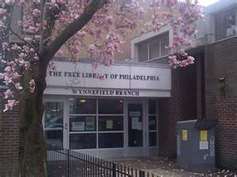 Wynnefield Library Anyone who knows me, knows I love libraries. If I have a few hours to myself, then I'll often find a library (or a coffee shop, these days) to read, write, think. And during my life, I've certainly had the opportunity to visit some beautiful and impressive libraries--Trinity College Library (Dublin), the British Library (London), the Oxford Library, the Biblioteque Nationale (Paris), the Newberry Library (Chicago), the Free Library of Philadelphia (main branch)...to name a few. And certainly, I live near some lovely libraries now in Highland Park and Lake Forest (Illinois). But for me, the most beautiful library in the world is the Wynnefield Library, a branch of the Free Library of Philadelphia, located just a few blocks from where I grew up in West Philly. It's not fancy, it's not glamorous--in fact, the modest 1960s exterior has a lot to be desired visually. A gently flowering tree gracing the red brick walls might look to be the library's only beauty. Certainly, no Baroque drama, no Georgian curves here, not even a whit of Victorian indulgence to be found. 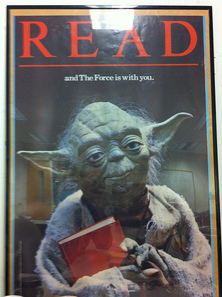 Posters like these urged kids to read The interior is equally simple. If I'm remembering correctly, a main circulation desk greets you when you enter, and just after, the young adult section. Beyond that lay the Adult Reading Room. (I only ventured in there looking for my mother, usually finding her in the mystery stacks. To this day, I'm fairly certain that the area would still feel off-limits to me).
To the left, the children's area awaited. There, the children's librarians (especially dear Ms. Naismith) knew our names, often greeting us with recommendations and new readings to share. As an inner-city regional branch, I can only imagine now how limited the holdings must have been, how few the copies of popular books, and how few new books ever went into circulation. Yet, I can remember leaving most days with one, two, three, even up to the maximum twelve books we were allowed to check out on a given day. (Thank goodness it wasn't twelve books total, especially with my--ahem--terrible allergy to returning books on time! I'd never get anything new.) The books were much-handled, many were stained, but I don't remember ever minding their careworn pages. The library brought us together in ways I can scarcely make sense of now. The librarians didn't just read us stories; they helped us form book clubs, let us put on plays, and stimulated our curiosity in new worlds. I remembering saying to a librarian once I couldn't find any more good books. She promptly introduced me to Tamara, a girl who lived near me, but whom I'd never met. Tamara in turn introduced me to Louisa May Alcott. Without this introduction, I might never have discovered one of my all-time favorite authors, or found a new friend. Clearly, the librarians simply loved reading, just as we did, and shared that love of reading with us. We weren't just "patrons" to them (or worse, kids to be ignored). The librarians viewed us as what we were: individuals, thinkers, and above all else, readers. The Wynnefield Library may not have had much, but in its beautiful humble way, it sustained and nourished a community. What do you think? What's the most beautiful library? 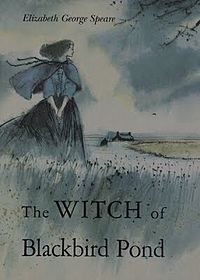 Last week, I came across an article that suggested that reading a book for a second time can offer mental health benefits. My first thought was, "Oh, this is great! I'm not crazy!" I said this because I've re-read certain books more than once a year--some since I was a child.(And with any luck I've benefited mentally in the process...)
This got me thinking about why I read certain books again and again, and the impact that some of those books have had on me. Some offer the comfort--and delicious anticipation--of a well-trodden path (Pride and Prejudice, Anne of Green Gables, Lloyd Alexander's Prydain Chronicles, and now, Harry Potter). Others offer the dream of a different world (The Time Quintent by Madeleine L'Engle, and now, The Hunger Games), or tugged at something in my being-- (For example, I can see now that Little Women and The Little House books directly contributed to my desire to be a teacher). Reflecting now, however, I think the book that may have had the biggest impact on me as a historian--and as a writer--was The Witch of Blackbird Pond (1958), by Elizabeth George Speare. Set in late seventeenth-century New England, this Newberry winner tells the story of Kit, a hoity-toity miss from Barbadoes, who accidentally defies convention, ruffles the Puritan community, and comes to be accused--and tried--as a witch. Richly drawn characters, simple but elegant writing, and a delicately plotted narrative make this book, for me, a model for powerful storytelling. Even more importantly, sitting down with this book--even as an adult-- makes me feel like I am sitting down with a friend. I'm curious--what books comfort and inspire you? Are there books that you seek out, to re-read and enjoy again? What makes you want to read a book again? (I'll read your comments when I finish re-reading my book...) |
Susanna CalkinsHistorian. Mystery writer. Researcher. Teacher. Occasional blogger. Categories
All
Archives
May 2023
|
 RSS Feed