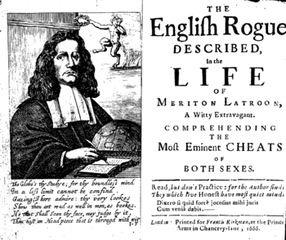
 When I was first writing Monster at the Gate, I toyed with the idea of writing the whole book in authentic seventeenth century prose.
That idea lasted about two seconds. Partly because that trick's been done, you know, by actual writers from that time period, like Defoe. And partly because I thought readers might throw rotten tomatoes at me for writing in such a cumbersome manner (heck, I might throw them at myself). But mainly, it was because many seventeenth-century words and phrases don't translate readily today, and unless my editor lets me write a companion volume with glossary and explanatory footnotes, I don't think it would work (assuming I had the patience for such an endeavor, which I don't). For example, criminals and thieves created their own language, "cant," which was deliberately designed to hide their shadowy doings. Amazingly though, a few curious contemporaries, such as Richard Head, decoded this elusive criminal language in cant dictionaries (similar to modern slang dictionaries), basically as a public service to let their readers in on what the criminals were doing. So, for example, a thief might Bite the Peter or Roger (which our good Richard tells us means "steal the port-mantle or cloak-bag"), proceed to Tip the Cole to Adam Tyler ("give what money you pocket-pickt to the next party") , who might take it then to a stauling ken(a "house that wyll receaue stolen ware.") (I guess we'd say 'fence?'). Some phrases are even harder to translate. So, say a broadside depicts what happens to a criminal who is caught. It might read: “As the Prancer drew the Quire Cove at the Cropping of the Rotan through the Rum pads of the Rume vile, and was flog’d by the Nubbing-Cove.” Huh? Any guesses? No? Really? Well, according to J. Coleman's History of Cant and Slang Dictionaries (Oxford, 2004), that statement translates to: “That is, The Rogue was drag’d at a Carts-arse, through the chief streets of London and was soundly whipt by the Hangman.” You probably knew that. Awesome stuff! But I'm curious. Have you read any terrific (modern) books that were written completely in dialect? Did you find them hard-going? fun? or something in between?
9 Comments
Jen
1/3/2012 03:46:59 pm
That's definately a foreign language.
Jen
1/3/2012 03:51:47 pm
Cupcake Brown's writing gave me the feeling that I was listening to a friend tell me her story. In a different style, I wouldn't have enjoyed this book.
Matt
1/3/2012 10:10:52 pm
Super cool! This reminds me of the short-hand that modern criminals have in movies, like Ocean's Eleven when Brad Pitt's character says,
Matt
1/3/2012 10:27:24 pm
Oh, and to answer your question, I haven't read anything in dialect recently. I'd imagine that it might be fun for about the first 10 pages (having a companion reader, deciphering the language--essentially solving a puzzle). But, then I think it would get tedious for me.
Jaynes
1/4/2012 02:46:33 am
I have read a few books where the authors are sitting on the edge of the Dialect pool splashing their legs around without fully jumping in. But we are talking 100 years max in the past, the phrases and words are still manageable. And to give the reader a break, they only have certain characters talk that way. It adds some authenticity to the story without making the reading experience a chore. Jaynes, I like the image of sitting on the edge of the dialect pool and splashing your feet around. I like to sprinkle, sprinkle, sprinkle, but not saturate myself. Its an interesting thing about translations though--there's always that risk that some subtleties or complexities are lost. For example, I've heard many people complain that "The Girl with the Dragon Tattoo" was a boring read, but in the original language (swedish?) the language is considered exquisite. So maybe that's an example of going from great to good. I think in the hands of a skillful writer, ongoing dialect can be quite nice. 9/15/2013 11:25:58 pm
There is nice post on the topic because its content all the point is very useful for everyone. I really appreciate your work or thanks for sharing your view by this knowledge post. Leave a Reply. |
Susanna CalkinsHistorian. Mystery writer. Researcher. Teacher. Occasional blogger. Categories
All
Archives
May 2023
|
 RSS Feed