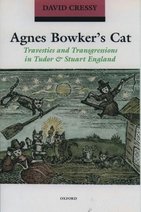
 The woman who gave birth to a cat (really!!) has to be one of my favorite stories from the archives. Poor Agnes Bowker--a young woman who did not want to admit what had happened to her child--claimed in 1569 that a monster (actually an ordinary feline) had emerged from her womb. None of the six women present at the birth could say for sure what had happened. Although a silly tale, the case was investigated thoroughly, as the Tudor government had a vested interest in maintaining order. And widespread gossiping about the supernatural was decidedly disorderly. 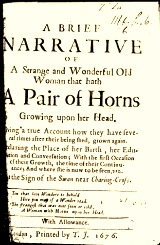 As I've mentioned before,such cases ("true accounts," "strange newes"; "wonderful happenings") have done much to inspire my own writing. But what's the truth of them? We can't completely know. We do know such stories shed light on how early modern villagers and townspeople understood the world around them, often revealing thinly disguised wrongs, moral tales, and political allegories. Some simply targeted people different from them, such as the "wonderful old woman" who had "a pair of horns growing upon her head." 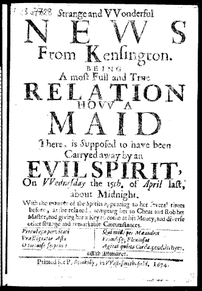 Others disguised everyday criminal events. The "Strange and Wonderful News from Kensington" (1674), for example tells of a maid "carryed away by an evil spirit" convinced to steal heartily from her master. (The Devil made her do it, anyone?) Whether anyone actually believed this servant is another question altogether. But of course, booksellers were looking to make a penny. And that tradition has kept many a tabloid in business. Some classics are apparently worth keeping. Just as the seventeenth-century bookseller once warned that a "True and Wonderful serpent (or dragon)" had been lately discovered in Horsam,the National Enquirer duly informs us that the Loch Ness Monster has been found by GoogleEarth! 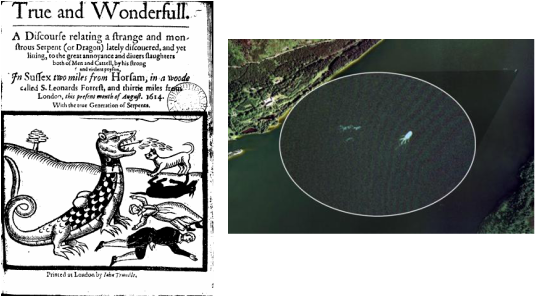 Compare the 17th century discovery of a murderous serpent with GoogleEarth locating the Loch Ness monster! Are we really so different today? We may feel more rational, less credulous--but are we really more "truthful?" Have we just found new, re-imagined, more scientific ways to explain the inexplicable? What do you think?
12 Comments
Matt
1/22/2012 12:11:47 pm
Oh, the things that will grow from the grains of truth! Matt, that's very similar! Those Oliver Sack's tales are equally intriguing. In the case of Agnes Bowker, though, there may have been several people in on the reimagined truth/lie (the midwife may have helped spread the story, for Agnes' sake). I do wonder what a clinical psychologist would have made of Agnes!
Lina
1/22/2012 12:13:01 pm
First of all, I don't know I am Lina now but since I have been using this name on you blog, I might as well become one. :-) Lina--yes, I did have a dream like this when I was pregnant with my first child! I remember thinking, oh my goodness, I'm a modern day Agnes Bowker!!! I also remember when I took my cat to the vet they brought him over to me, all swaddled, and I wondered why the vet was bringing me a baby. Imagine my surprise when I looked down and saw my fluffy little cat peering up at me! And I forgot to say, Lina, that you're completely right how susceptible we are in the face of authority, especially when we have a lot to lose (love, respect, our fingers...yikes!) those kinds of moral tales really help keep us check though, don't they? And maybe I should check with our psychologist friends, but I wonder if we as humans are less likely to question with certain kinds of authority, such as that which comes from our parents.
Sleeping Gypsy
1/22/2012 11:44:37 pm
Can you explain the pervasiveness of the Gnome/ Elf/ Duende/ Brownie/ Leprechaun.... mythology that seems to be ubiquitous around the world? Are there similar types of stories in the literature during these time periods that you've encountered? Sleeping Gypsy, this is a really interesting question! I did a quick search (never having heard of the Duende (a fairy-goblin-like creature with Spanish origins). Many cultures do seem to have similar traditions about these fairy folk (although they seem to vary in how helpful vs mischievous they are, as well as in their capacity for kindness and cruelty). From what I can see, these traditions seem to share early medieval roots, although oral folk storytelling may have preceded anything that was written down in the early modern period. The first writing about "gnomes", of Scandinavian origins, seems to have been by Paracelsus in the 16th century. the question for me, however, is why did different cultures opt to create these types of mythological figures? For entertainment of course,but perhaps also to explain why good and bad things happen. What do you think?
bekerys
1/24/2012 03:57:08 am
So now we can guess at the origin of the expression "she was so upset she had kittens!" Beckery...ha! that's funny. I'd forgotten that phrase. I think its a Brittish-ism, sort of along the lines of "don't have a cow." Although 'don't have a cow' makes no sense. I guess the idea is that mother cats are very anxious when they are having kittens. There are some unsubstantiated alternate explanations floating around on the web as to the origins of that term. I checked the OED, but that does not give phrases. I looked at some idiom dictionaries, which attribute it to Oscar Wilde in nineteenth century, which doesn't seem early enough. I did see that there were some early modern references (1654) of a Scottish woman being warned by a witch that she was growing kittens in her belly instead of a baby, but I could not find a reference to document that one. Agnes Bowker's case was pretty well known, but I don't have any evidence that it led to that expression. But maybe it did!! great observation! 8/25/2013 09:33:51 pm
Though it comes from some the innermost imagination it is quite good to hear your thoughts and your blogs are indeed a good platform to exhibit your thoughts. Deeply philosophical but yet meaningful this brings the best in you out and makes you stand out. 10/10/2013 05:18:40 pm
I am happy that I found your post while searching for informative posts. It is really informative and quality of the content is extraordinary. 9/15/2018 01:22:49 am
*Hello! I just would like to give a huge thumbs up for the great info you have here on this post. I will be coming back to your blog for more soon. Leave a Reply. |
Susanna CalkinsHistorian. Mystery writer. Researcher. Teacher. Occasional blogger. Categories
All
Archives
May 2023
|
 RSS Feed