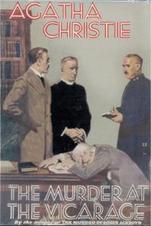
 original 1930 UK edition Recently I've been thinking about the history of female sleuths--at least of the literary variety. I'd assumed that the first had emerged in the "Golden Age of Detective Fiction" (the period between World War I and World War II, when many great fictional detectives emerged). Certainly, two early female sleuths were gentle Miss Marple and the intrepid girl detective Nancy Drew, although neither was the first female detective. Miss Marple first emerged in one of Agatha Christie's short stories ("The Tuesday Club Murders") in 1925, although she was not featured in a full-length novel until The Murder at the Vicarage was published in 1930 (Check out the original cover above. Anyone missing? Hmm...). 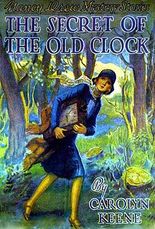 the chic 1930s detective Interestingly, the first Nancy Drew mystery (The Secret of the Old Clock) was also published in 1930. (The authorship has been much contested, and the stories have been much revised, but the pseudonym "Carolyn Keene" is understood now to be the creation of Edward Stratemeyer and a series of ghostwriters, including Mildred Wirt). In many ways, Nancy Drew and Miss Marple could not be more different. Miss Marple elicited friendships over tea, making sense of gossip, while Nancy listened at keyholes, regularly finding herself captured or bopped over the head. Miss Marple was a lively middle-aged "spinster" who demonstrated wit and wisdom, while Nancy was a titian-haired teenager, later college student, who was highly skilled at everything. Yet, arguably, both sleuths were products of the Great War. Miss Marple had lost her fiance and chose to make her own way in the world. Nancy had benefited from the nascent women's rights movement in the U.S, believing without reservation that she could do anything that men could do, including catch criminals. 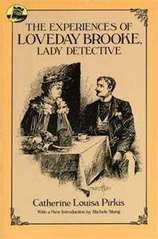 Loveday Brooke at work With a little more digging, however, I found that the Victorians had actually produced the first female detectives. In 1864, Andrew J. Forrester Jr. introduced Mrs. G. in the Female Detective, and other female sleuths followed soon after. These women seem to have represented a different type of reformer--rather than those who sought to reform prisons, factories and mills, and schools, these female detectives seemed to be suggesting a reform of the police force.
The first female sleuth I could find that had been created by a female author was Loveday Brooke, in Catherine Louisa Perkis' The Experiences of Loveday Brooke, Lady Detective (1893). Loveday Brooke, destitute at 30 years old, had defied patriarchal convention to join a detective agency. Much like her better known contemporary, Sherlock Holmes, Loveday relied on her intellect and logical thinking to suss out her criminal adversaries. She offered a counterpoint to the widespread belief in the late nineteenth-century that women were emotional, hysterical, and incapable of logical reasoning. In many ways, these sleuths seem to reflect something of their times. It makes me wonder, first, how my own amateur sleuth, Lucy Campion, might be a product of my experience? It also makes me wonder generally about more recent trends of female sleuths who have (more-or-less successful) crafts, businesses, and hobbies on the side, which inform their crime-solving capabilities. Just curious: Do you think characters (sleuths or not) are still products of an author's time? And if you don't like that question: What sleuths or detectives (female or male!) do you enjoy? Why?
15 Comments
3/3/2012 03:37:30 pm
I much enjoyed and appreciated your post on female sleuths. In this connection, Jenno Bryce did some fictional sleuthing back in 1941. It's recorded in "Gang Spies". If you're interested, there's further information on my website. Thanks and very best wishes, Peter 3/5/2012 12:08:27 am
When was 'Strong Poison', Dorothy L. Sayers' first Harriet Vane and Peter Wimsey mystery, published? 1930? The first Wimsey book, 'Whose Body' came out in 1923, although Sayers have begun work on it as early as 1920. M.M. I love Dorothy Sayers too! I did double check, and while Harriet Vane appeared in the first book (Whose Body), I guess she doesn't actually "sleuth" until "Have His Carcase" in 1932. But I won't quibble about a technicality--she and Wimsey were a great team!! I love the books from this era!
Matt
3/6/2012 04:45:31 am
I've always wondered whether the small village of St. Mary's Mead (that is, Miss Marple's hometown) was ever considered to be the "murder capital of the UK"? The ratio of murders to residents must be off the charts. Is there another small village that even comes close?
bekerys
3/6/2012 08:30:23 pm
That's an excellent question, Matt. And here is something I have always wondered: if you are not a cop, or a professional PI or ME, what would the police really think of you if you keep finding dead bodies at, in, or near your coffee shop/donut shoppe/kraft kove etc? Wouldn't they really start to wonder about you? Matt, that's funny! I think in one book Miss Marple was looked at a bit askance by some new policemen in town. I think that's why she had to start visiting relatives, taking cruises etc, to get away from the murder capital. I hope I don't have that problem in my series! Lots of murders committed in London, right? :-)
Matt
3/7/2012 05:45:30 am
Oh yeah, no problem in London. :-) I'm glad that I don't work for St. Mary's Mead Tourism Bureau. I wonder if they have a sign in the town square that says "__ Days since Last Murder"
bekerys
3/7/2012 09:33:33 pm
Let's hope for the intrepid Lucy's sake that she herself does not have to find too many of the victims. I'm sure discovering dead bodies is most disquieting!
I once got in a rather heated exchange with a man who felt that there could not have been anyreal female detectives in 1890 London (thus discounting my own creation of Rebecca Bowen). 3/25/2012 09:22:48 am
Sable Jak, that WAS a narrow view expressed by that gentleman. To simply say there were no females who investigated mysteries and crimes before the late nineteenth century--just because they were not well known or documented--is myopic indeed. Women have been spies, detectives, and thieve-takers since the beginning of humanity! Thanks for commenting; I will have to look up the article by Chris Willis. 6/25/2013 07:54:10 pm
I really enjoyed this article regarding female sleuths and this wonderful piece of write up gave valuable information about authors like Miss Marple and Carolyn keen, the detective stories with female lead characters was a real sensation during the past and I think it will be appreciated now also, good job guys! Leave a Reply. |
Susanna CalkinsHistorian. Mystery writer. Researcher. Teacher. Occasional blogger. Categories
All
Archives
May 2023
|
 RSS Feed