|
I can't be the only one who's stared at "Dogs Playing Poker" wondering what the artist was thinking (or drinking, smoking, etc.) when he dreamed up this crazy, but fun, image. 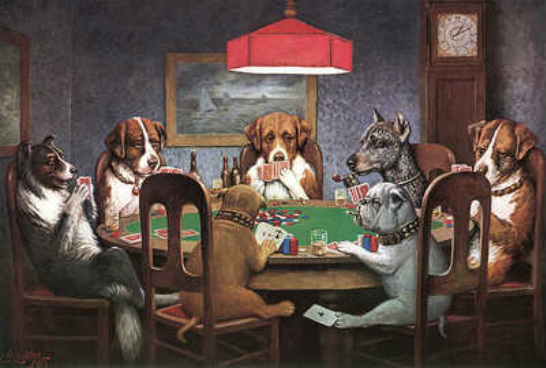 Exhibit A: "A Friend in Need" (part of "Dogs Playing Poker" series) Who doesn't love the bulldog passing his friend the ace? Pure unadulterated American kitch! Or is it???! I will call this painting Exhibit A. I ask you now to consider Exhibit B, below. 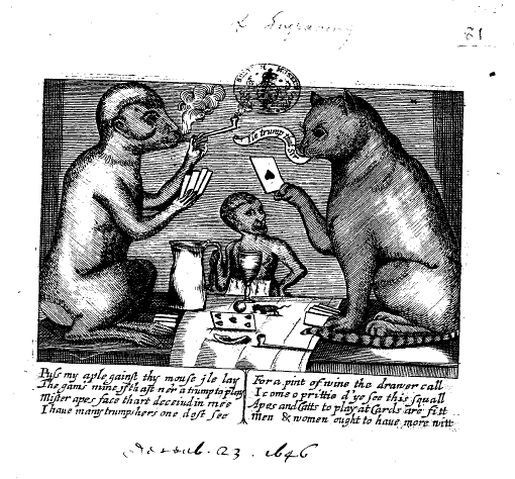 Exhibit B: Apes and cat playing poker (well, cards--there was no poker yet) Exhibit B was created by Anonymous in London 1646. Now, compare the two pieces carefully. Some differences...monkeys and cats, not dogs. A trumping card game, not poker. Some odd verse under the second one. But otherwise, Exhibit A and B are exactly the same, right? Both feature animals smoking, drinking, and, well, playing cards. An ace is prominent in both. Clearly, Coolidge's twentieth century collection was inspired by the seventeenth-century piece. No, I kid! When I came across Anonymous' (1646) woodcut, I was just struck by the superficial similarities to the more famous paintings. Actually, as you might surmise, since these two pieces had entirely different purposes and images, that it's rather silly to compare them. But I will anyway... As the story goes, C.M. Coolidge was commissioned by an advertising firm, Browne and Bigelow, in 1903 to create the iconic series of oil paintings, collectively called "Dogs Playing Poker." The purpose was to sell cigars. (In Exhibit A, after the viewer takes in the ace, his or her eye will also be drawn to the smoking pipe just behind it). On the other hand, the Thomason Tracts catalog says the woodcut in Exhibit B is "An engraving representing a monkey and a cat playing at cards; with descriptive verses denouncing card-playing." The text underneath the image reads: "Puss my aple gainst thy mouse Ile lay The gam's mine ifth aft n'er a trump to play. Mister apes face tart deceived in mee I have many trumpsters one dost see. For a pint of wine the drawer call I come o prittie d'ye see this squall Apes and catts to play at cards are fitt Men and women ought to have more witt." Huh? Basically, Anonymous was taking a good Puritan stance against card playing; after all, Cromwell's Parliament had banned all gambling and gaming by the mid-seventeenth century. And nothing depicts moral decay and mental decline more readily than apes and a cat playing cards. So maybe the two pieces had different--okay, completely opposite--messages. Or-r-r-r, maybe we've hit on the secret seventeenth-century Puritanical origins of "Dogs Playing Poker." What do you think? You tell me! 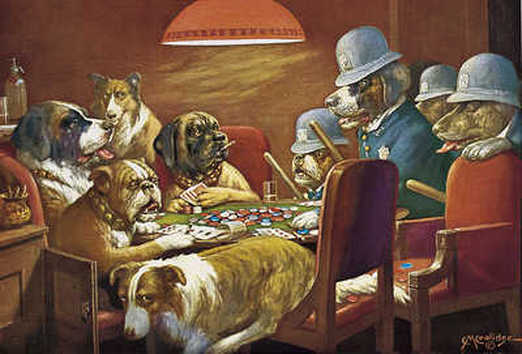 (And just because these are so much fun, I'll leave you with "Pinched with Four Aces" to ponder. Discuss amongst yourselves!)
18 Comments
bekerys
3/10/2012 03:52:02 am
Very interesting. But what game would cats be playing if cats were depicted? Why, Go Fish, of course. I always just thought (when I thought about it at all) that this was taking a good-natured jab at the pure-bred gentlemen who had nothing else to do but lose their money and inheritances at the card tables. Leave it to an historian to dig deeper....
Susie
3/11/2012 12:57:03 am
I really liked this comment I received via twitter, so I got crime writer's Michael Gregorio's (http://www.michaelgregorio.it/) permission to paste in. He sad: "Nice piece! Using animals as symbols of vice was common in the past. You dog! Promoting vice (gambling) is a 20th century phenom." Michael is completely right--criminals, Satan,and the different vices were regularly portrayed by common domestic animals (cats, dogs, goats, etc, especially those animals with horns).
Matt
3/12/2012 01:05:08 am
You had me at 'dogs playing poker.' This blog reminds me of a line from a BNL song, "It's all been done before." I wonder if there were also ancient Egyptian paintings of gambling cats or cave drawings of elk playing games of chance?!? 8/10/2012 12:53:39 am
As an artist, this is one of my favorite pieces of work. Havig just completed my own piece, titled, "The Descendants," I more than ever appreciate your fine historical perspective. My dogs have a surf board and are playing inside a log cabin in Yosemite with Yosemite Valley clearly out the shuttered window. 9/27/2012 07:05:09 pm
There some very impressive points in your blog. I must appreciate your excellent work. I find the blog post very interesting and moreover very informative. I am thinking to write a piece on related topic. Will definitely share it and waiting to read some more interesting blogs from you. 9/24/2013 04:43:47 pm
Basically, anonymous was captivating a high-quality Puritan posture against card playing; following all, Cromwell's Parliament had banned all gambling and gaming by the mid-seventeenth century. And nothing depicts moral decay and cerebral decline extra freely than apes and a cat playing cards. 10/5/2016 03:33:52 pm
but the cash winnings some players have scored will make this app appealing to experienced poker masters as well. 9/27/2022 04:57:21 am
What an exquisite article! Your post is beneficial right now. Thank you for sharing this informative one. If you're looking for a money-making app, download this link https://bit.ly/3MSDRA9 10/25/2022 11:52:16 pm
Thanks for the information l read your article l am very impressive 1/12/2023 05:32:10 am
Excellent article! Thank you for your excellent post, and I look forward to the next one. If you're seeking for discount codes and offers, go to couponplusdeals.com. Leave a Reply. |
Susanna CalkinsHistorian. Mystery writer. Researcher. Teacher. Occasional blogger. Categories
All
Archives
May 2023
|
 RSS Feed