 Interacting with Mars The other day a faculty member who teaches college science courses shared with me an innovative method he uses to enhance critical and creative thinking in his students.
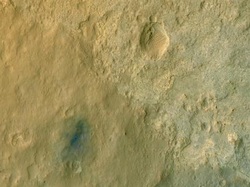
Instead of having his students complete more traditional reports on scientific principles and concepts, he has them create science fiction stories, drawing on those same scientific ideas. (Boy would I have loved science if my professors had asked me to do that!). As we talked, we discussed the necessity of not just asking students to sprinkle scientific details through their stories, but rather the importance of having their characters engage with those details. This would add to the scientific authenticity. More importantly, I think they contribute to the overall richness of the story. So, for example, a writer could just passively describe Mars: "The floor of the Gale Crater was grayish-blue in color. Brown and gray pebbles were strewn everywhere. At the center of the crater was Mount Sharp. Without any sign of life, Larry thought it was definitely the perfect place to land the Motherland's craft." Or, the characters could actively engage with the Martian terrain--as they would engage with another character: "As Larry stepped cautiously down from his craft, his boot sunk a little deeper down into Gale Crater than he had expected. What he had thought would be thickly-layered bedrock was actually more sponge-like in its composition. This was not the first time the Motherland's Minister of Science had been wrong about a planet. He kicked one of the many brown pebbles strewn across the landscape. "It's going to take me forever to get to Mount Sharp," he muttered to himself. "Why'd the General tell me to land here? The mountain's at least three kilometers to the north." Shivering, he checked the temperature gauge on his suit. 66 degrees. "Geez, it's dropped at least 10 degrees since I landed." Out of the corner of his eye, he saw one of the pebbles move. "Uh, oh." He groaned. "That's no pebble!" Okay, there's a reason I don't write science fiction. But when I was first embarking on my novel-writing journey, I learned about the concept of treating description, scenery, weather, etc as another character. Details should be added to enhance the experience of a character. In A Murder at Rosamund's Gate, for example, I turned the ever-present London fog into a character--alternatively gentle and tempestuous in turns. Of course, this is a matter of taste. There are plenty of great books out there--especially some of my favorite nineteenth century novels--that have PAGES and PAGES of description without a bit of dialogue or action to break them up. But I admit, I probably skim long passages of description for the most part. How about you? Do you enjoy books with lots of scenic descriptions? Or do you prefer when characters engage with the scenery, as they would engage with another character?
14 Comments
8/15/2012 01:03:29 pm
Aside from the issue that the poor guy really needs a better-insulated spacesuit, either treatment works well for me; depends more on what tone the author is shooting for.
Matt
8/15/2012 01:14:30 pm
Although I pride myself on reading every word in a book, I am much more likely to fight the urge to skim when there are looong sections of description. I much prefer the integrated style, but I also enjoy chocolate in my peanut butter, and vice-versa.
bekerys
8/15/2012 09:04:27 pm
Is that 66 degrees in Fahrenheit, Celsius, or Kelvin, or Martian? And what happens next with the pebble? Bekerys, I had looked it up; apparently in summer, it can get as high as 80 degrees Farenheit. But really, as Jeff points out above, that's a pretty poorly insulated spacesuit. I guess I'm used to writing about seventeenth century cloaks and frocks :-) And...so you want to know about the pebble, eh?
Mary Lesniak
8/16/2012 02:16:45 am
My absolutely favorite author is Tolstoy. I love reading the long descriptions of what the character is seeing, or of the situations around him/her.and how it affects the characters actions. It enables me to crawl inside the character to experience exactly what he/she is and I believe you understand the characters actions/thinking on a more personal level.
Jaynes
8/16/2012 05:52:52 am
Yet another brilliant piece of advice for aspiring writers. I think these minor details separate the Pros from the Amateurs. A few years ago if you had asked me why I enjoyed one book over another in the same genre, I don’t think I could tell you in words. But I am starting to understand why, when you uncover these tips. I’m reading an old school sci-fi story from the 40’s about atomic jet cars on Venus, paralyzing ray guns and wait for it…watches powered by electricity…But they are introduced into the story by character use…never as a “guess what I see” kind of deal…
Jaynes, I'm positive I hadn't thought about this a few years ago either. Not until I started reading books on writing.
Jaynes
8/21/2012 02:55:57 am
I would be amused if everyone took a shot at a paragraph describing what happened next with the pebble. I think I sense some other writers responding on this blog. We could see how we measure up to your talent...Little friendly competition... 8/20/2012 02:06:37 am
The SF genre is replete with stories that hinge on environmental conditions. The better authors probably use both directions with equal success. Le Guin and Herbert come to mind. After hundreds of pages, possibly mostly descriptive, Herbert went so far as to literally transmogrify the desert into the worm-god Leto. Ged's shadow can be seen reflected in Earthsea's waters - three characters in three different states of existence. Leave a Reply. |
Susanna CalkinsHistorian. Mystery writer. Researcher. Teacher. Occasional blogger. Categories
All
Archives
May 2023
|
 RSS Feed