|
My fourth book has had several different titles, but none that really resonated with me or with my editor.
I've talked before about the image that prompted this novel initially--although, alas, that too has changed somewhat--and about the difficulties I've had with titles generally. But naming a book is a difficult thing--it has to be right! The new title--A DEATH ALONG THE RIVER FLEET--feels right. (I mean, I also liked Murder at Fleet Ditch, but it was deemed a bit too harsh for my Lucy books, which I can totally see now). Here is the working premise: Crossing Holborn Bridge, where it crosses the River Fleet, Lucy Campion—printer’s apprentice--encounters a distraught young woman, barely able to speak and clad only in a blood-spattered nightdress. To the local townspeople, the woman is mad, afflicted with the devil’s tongue, but Lucy, feeling concerned for the woman’s well-being, takes her to a physician. When the woman is shockingly identified as the daughter of a nobleman, Lucy is asked to temporarily give up her bookselling duties to discreetly serve as the woman’s companion while in the physician’s care. As the woman recovers over the month of April 1667, she begins—with Lucy’s help—to reconstruct the terrible event that occurred near the bridge, as well as the disturbing events that preceded it. When the woman is attacked while in her care, Lucy becomes unwillingly privy to a plot with far-reaching social implications. But, given that I don't like to disclose too much about my work-in-progress, this is all I will say!
2 Comments
 Maps that inspired Lucy's London As I work on my fourth Lucy book, I knew I had to figure out a better way to keep in mind where all the events of the first three books occurred. For real historical locations--London Bridge, the Cheshire Cheese, St. Martin-in-the-Fields, the Fire Courts, Newgate--I have a few maps on hand. These include the interactive map of early modern London ("The Agas Map") from 1633 and Walter George Bell's 1920 map of the Great Fire of 1666. But of course it is Lucy's world that is harder to keep straight. Where does Master Hargrave live? Where is Aubrey's printing shop? Where was Mr. Whitby pushed in front of the horse? How long will it take Lucy to walk from Duncan's jail on Fleet Street to the nonconformist burial ground in Bunhill Fields? And when Lucy walks towards Smithfield, will she remember where a murder occurred in an earlier book? This weekend it occurred to me to create my own master map--Lucy's London--for me to remember where every event occurred in Lucy's life. Using photocopies of the Agas Map (1633) and using Bell as a reference, I was able to develop my own map on which I could color in the area destroyed by the Great Fire and write in all my events for reference. The final result, shown here on my dining room table, is about 5' x 2.5'.  My master "Lucy's London" map drawn from MoEML Agas Map and W.G. Bell.
If I wanted I could even color in all the houses! Draw journey lines to illustrate the different treks the characters take throughout all four books, noting their points of intersection! Use a palate of colors to demarcate a range of events--murders, accidental deaths, accidents, important scenes!
Or, not. I do, after all, have a book to write. But working on this map gave me an enormous appreciation for the intricate nature of the maps that Agas and Bell created, and deepened my understanding just that much more of the fascinating world of early modern London. 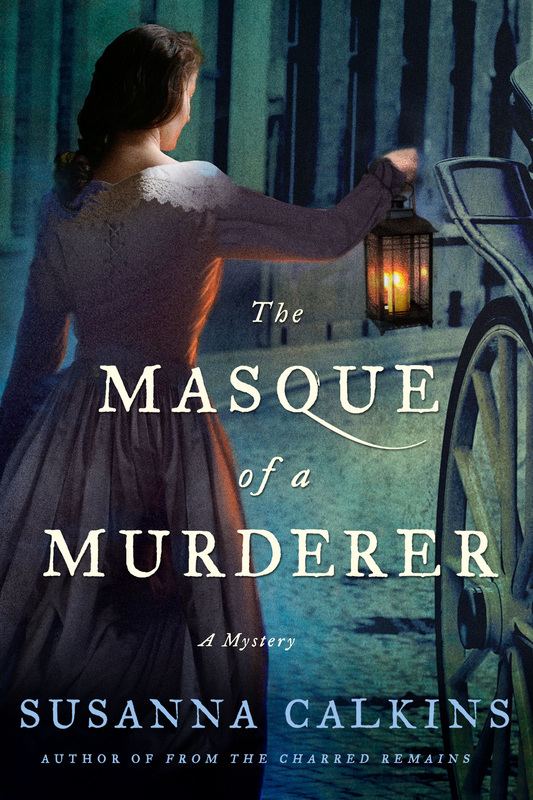 Coming April 2015, to a bookseller near you!!! More to come....
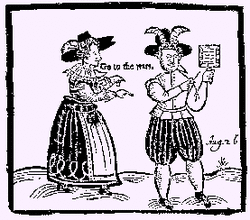
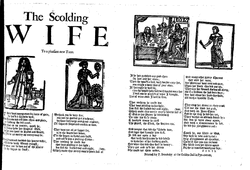 The scolding wife Date: 1670-1696 Tract Supplement / A2:4[78] I won't say HOW exactly, but a scold's bridle features prominently in my third novel, Masque of a Murderer. (Well, okay, maybe one is found on the corpse of a young woman. Or not.) But the bridle does play an important role, and I thought I would give a little more background. Since at least the Middle Ages, women had been expected to heed Paul's admonition to be "chaste, silent and obedient," an expectation that became even more pronounced for women in early modern Europe. Women were branded "scolds" if they harangued their husbands or neighbors, or as we may say today, spoke their minds. "The Scolding Wife," shown here, is one of many tales of a merry young man who made the mistake of marrying a rich widow who very quickly made his life miserable. Indeed, the couple couldn't even sit down to eat without her scolding him: "They was not all at supper set, or at the board sat down, Such accounts explain how the men's good will and cheer are sapped by the woman's speech. It should be noted, however, that the tale is to be 'set to a pleasant tune.' The ballad is meant to be lighthearted--an everyday tale of a man who cannot control his wife. As such, it is as much a comment about his nature as it is about hers. Nevertheless, there is a gendered warning here about the respective roles that men and women should play in a marriage. My favorite of these little discourses is one by Anonymous (1684): "The tongue combatants, or A sharp dispute between a comical courageous country grasier, and a London bull-feather'd butchers twitling, twatling, turbulent, thundering, tempestuous, terrifying, taunting, troublesome, talkative tongu'd wife." Hmmmm..... 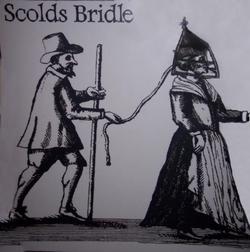 Sometimes, however, the warning against women's scolding was more explicit--and more terrifying.
Devices known as scold's bridles, or scold's masks, first emerged in the Middle Ages, and continued to be used (in England at least) throughout the early modern era. The scold's mask was a painful contraption of iron and leather that fit over a woman's face that effectively prohibited her from speaking. Sometimes, the woman might be paraded about, as a humiliating reminder to keep her opinions to herself, and as a lesson to other women who might be inclined to do the same. So how does this play out in my novel? Find out in April 2015, when Masque of a Murderer is released! I am excited that Sam Thomas, author of The Midwife Mysteries, was able to join me on my blog today! To celebrate the fact that The Midwife's Tale is now available as an E-Book for just $2.99, Sam shares the story behind his cover! (Head over to Amazon or Barnes & Noble to pick up your copy!) One question that a lot of readers have asked is how The Midwife’s Tale wound up with its cover, and whether I had any say in its creation. It’s a pretty great question with an interesting answer. When I envisioned the cover of The Midwife’s Tale, I wanted it to look like a seventeenth-century book, largely in keeping with my original title, Bloody News from York. The image I had in mind was something like this book from 1635: 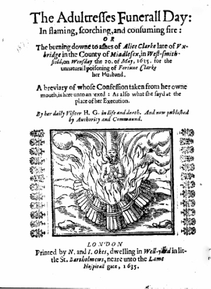 I thought that this cover would both capture my setting and the central tension of the book, whether a woman would be burned at the stake. Unfortunately, kept this idea to myself for a bit too long, and before I said anything to my editor, he sent this cover: 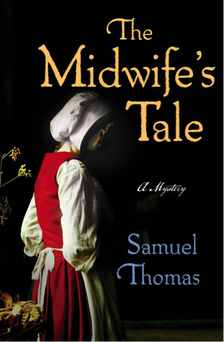 I was floored. I loved the darkness, the color scheme, the way the light played across the figure’s back… nearly everything about it. The one concern my agent had was that it seemed a bit too still. I had written a murder story, after all, and he thought it could use a bit more danger. We suggested putting a knife in her hand, and perhaps replacing the stalks of grain on the table with a mortar and pestle. This is where Minotaur came through for me the first time. By all rights, they could have said, “Nope, this is it.” But they didn’t. They came back with a modified cover:   Among the many things I never expected when I began to publish my historical mysteries is the steady stream of questions I get from readers. I really enjoy getting these questions, but sometimes I'm a little perplexed.
The "easy" questions focus on interesting historical details, like how people kept time in the 17th century or what the revolving signet ring described in From the Charred Remains actually looked like. Sometimes they focus on larger questions, such as the gendered nature of the printing industry, the so-called "miracle" of the Great Fire, and the like. Sometimes, I just answer these history-related questions in a quick email, but I will probably start answering them in more detail on this blog. However, what's interesting to me is the number of questions that I'm starting to get about the decision-making processes that accompany the writing of a novel, especially historical fiction. "How do I decide on a time period/setting for my novel?" "How do I begin my research?" "How much research do I need to do?" "How much historical detail is enough?" "Do I need footnotes?" I hate to say it, but all of these questions can be answered in a single phrase. It depends. I know, I know. That's not very helpful. Since I've written at length in Writers Digest about seven tips for writing historical fiction,"Balancing accuracy and authenticity in historical fiction," I won't go into detail about those writing strategies here. And really, I don't have any particular insights about how to select an interesting time period. Choose a time period that fascinates you, intrigues you, keeps you enthralled. Keep in mind: this time period had better hold your attention, since writing a novel takes a very long time indeed! If you become bored with the time period, I have no doubt it will show in your writing, and your reader will become bored too. Truly, to answer such questions: "Have I done enough research?" "Have I offered enough historical detail?" "Do I need footnotes?" it really does depend on who your intended audience is, the kind of book you are writing, and the conventions of the genre. To answer these questions, there's a bigger question that you really need to ask yourself first: Am I actually writing historical fiction? This seems like a simple question, but I've been quite surprised when readers and writers ask me about the difference between history and historical fiction. It's clear to me now that there is a spectrum of categories, associated with the writing of history. None is "better" than another--each has a different purpose. I thought I would lay out how I conceptualize the difference in these categories: (1) Scholarly historical writing: This type of non-fiction writing is usually conducted by scholars and academics, produced in institutions of higher learning, museums and libraries, with highly specialized audiences and very small print runs with academic presses. Historical narratives and interpretations are framed by theory, historiography, with a strict adherence to evidence found in primary and secondary sources. Footnotes are crucial for credibility. Usually peer reviewed by other scholars/specialists before proceeding to publication. (2)Popular historical writing: This non-fiction writing may be very similar in scholarship to academic writing, but it may be more sensational in nature; it may be mass produced by commercial presses and readily found in bookstores; less emphasis may be placed on historiography and theory, but these features may still be present. Standards of evidence may be less strict. May not be peer reviewed, or only reviewed by editors. Generally, the writing seems more accessible and is intended for a lay audience. Footnotes are present, but are used more to explain ideas than to provide citations for every piece of evidence (again, this varies by publisher). (3) Fictionalized History: This is a tricky category to explain, because I think it is usually lumped together with historical fiction. I think this occurs when a writer takes a well-known historical narrative and adds to this narrative with made-up conversations and interactions between real historical figures. There is a great deal more supposition and creative license in constructing this type of narrative. Evidence may be selectively used to frame the overall story. Footnotes may be expected by readers. I think it is safe to say that this category can be called "Based on a True Story." (4) Historical fiction: While this varies, I would say that in this category, the historical narrative usually forms a backdrop to the story, with characters interacting with authentic details. Background theory and research will inform the best writing in this category, but will be implicit, not explicit. Historical fiction is not usually produced by academic presses, and undergoes editorial, not peer, review prior to publication. Much of the main plot may be fictionalized, even if there are real characters and true historic events being described. So in my case, the 17th century plague and the Great Fire of London form the backdrop of my stories, and my completely fictional characters sell murder ballads, spend time in Newgate prison, and scrub chamberpots. I do not have footnotes (ack! ack! not in a novel! Convention right now, at least in traditional publishing, is to eschew footnotes), but I do have a lengthy historical note in each book to explain historical points more or to indicate where I stretched the facts slightly to enhance the storytelling. I avoid information dumps, and try to get my characters to engage with the historical details. I'm telling a story, not writing a textbook. In any one of the above-mentioned categories, however, writers may be seeking to shed light on a little known historical event or figure, to expose larger truths, to offer new explanations and interpretations about a historical event or idea, or simply to provoke curiosity about a bygone era. One category is not BETTER than another; there are different purposes for each (and there are examples of good and poor writing in every category.) Ultimately, the level of historical detail and the length of the book will depend upon your intended audience (children, adults, scholars, history enthusiasts etc), the opinion of your editor and publisher, the conventions of your genre, and most importantly, the story you are trying to tell. But what do you think? Do these categories make sense? 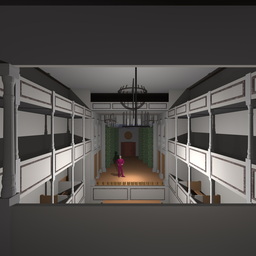 Reconstruction of Lincoln's Inn Fields While I work on my copy edits of The Masque of a Murderer, I thought I'd post something about Lincoln's Inn Fields Theater, which plays into my third novel. Lincoln's Inn Fields Theater interested me because it was one of the playhouses that King Charles II built in 1661 after he was restored to the throne. Ironically, it was not originally intended to be a theater, but a tennis court. (You can see the long rows of box seats on either side where an audience would have watched a match). The Lisle Court only became a theater in 1662, before being temporarily closed during the plague in 1665. [There may also have been a murder that occurred there, but somehow that tale has only recently resurfaced :-) ] In doing my research, I came across the work of Steve Bouler, a theater professional and academic, as well as being an extremely talented designer of virtually reconstructed theatrical playhouses. It's hard to express how immensely helpful these reconstructions are to a researcher. Since so many of these Renaissance and Restoration playhouses are now gone, we must rely on extant sketches that can be difficult to track down,and even more difficult to interpret. I know I spend a lot of time looking over faded sketches with teeny print, trying to figure out how everything fits together. But when I came across these reconstructions, I gained a far better sense of how plays would have been staged (and received). You'll understand when you check out Bouler's amazing panoramic reconstructions! Check it out! Image: http://historicalplayhouses.com/Lincoln_s_Inn_Fields.html
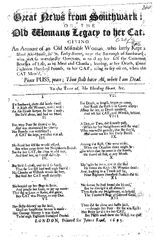
Oh, yes! It's exactly what you think. Read on! Naturally, the subtitle says it all... “Giving An Account of an Old Miserable Woman, who lately kept a blind ale-house, in St. Tooley-Streat, near the Burrough of Southwark; who was so wretchedly covetous, as to deny her self the common benefits of life, as to meat and cloaths; leaving, at her death, about fifteen hundred pounds, to her cat, using to say often, when the cat mow’d: “Peace Puss, peace: The poem that ensues is a bit silly but sort of endearing as well. (And I have to say, it was nice to see a relationship between a woman and her cat that was not wrapped in accusations of witchcraft, bestiality or other fantastical conjectures.) As the story goes, for years, this "mean" woman did not spend her money, preferring to keep her alehouse earnings to herself. Finally, when no one had seen her for a while, one of her neighbors went in to check on her: “Upstairs he went, and in the bed, He found the Rich Old Woman dead: And, looking in a truk just by, Near Eighteen Hundred Pounds did lie. No sooner he had found the hoard, But he divulg’d it all abroad: Then shockt the neighbours, to behold, The Treasur’d bags of coyned gold. Thus did she cheat the battle such, They thought her poor; for she was rich: Her belly saved it for her CAT, But Puss must shew the will for that." Unfortunately, there's no word on what the cat did with her legacy, but hopefully she was able to get a nice mouse cobbler from time to time.
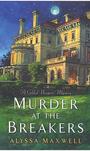
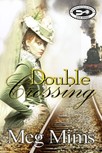
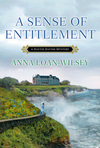
Not crazy though, right? 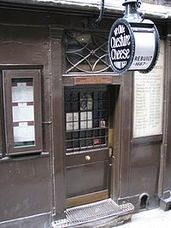 A little belatedly I am taking part in the September Sisters in Crime Sinc-Up for writers. (There are a few days left of September, right?) So one of the prompts was this question, "If someone said 'Nothing against women writers, but all of my favorite crime fiction authors happen to be men,' how would you respond?" Well, someone did say something along these lines to me once... I was at a mystery conference, and a fellow author introduced me to an older gentleman--I'll call him George--who apparently is a huge history buff. My friend told George that I write historical mysteries set in seventeenth-century London. George's eyes lit up and he told me that he had just been in London recently. I asked him what he had liked about his trip. George told me that he had liked seeing the Cheshire Cheese, a tavern that had been rebuilt in 1667 after the original was burnt down during the Great Fire of London. We-l-l-l-l....the Cheshire Cheese was actually the setting of my second novel--From the Charred Remains. In fact, I have a murder happen there just before the place burns down. So I told George this, and again, his eyes lit up. Then he asked me about my protagonist. I started to tell him about Lucy, my chambermaid-turned-apprentice, and he held up his hand and said, "I don't read books about women." Conversation over. Wha-a-a-a-a-a-a-a-t? I couldn't even begin to tell him about all the wonderful crime fiction that feature female detectives, sleuths, lawyers, reporters and a zillion other investigators that he was missing out on with such a dismissive stance. Patricia Cornwell's forensics specialist Kay Scarpetta. Rhys Bowen's amateur sleuth Molly Murphy. Kerry Greenwood's private investigator Phryne Fisher. Sara Parestsky's kick-ass V.I.Warshawski. Hank Phillippi Ryan's intrepid TV reporter Charlotte McNally. Not to mention the unflappable Miss Marple! And for anyone who likes strong female protagonists in historical mysteries, I've got a few that you MUST check out: Meg Mims writes the "Double Series" featuring feisty Western heroine Lily Granville; Anna Loan-Wilsey writes a terrific series set in New England featuring Hattie Davish, "a travelling secretary and dillettante detective," and Alyssa Maxwell writes the charming Gilded Newport Series with Emmaline Cross--"a Vanderbilt by heritage, a Newporter by birth, and a force to be reckoned with!" Well-written historical mysteries all! Hopefully we can turn the Georges of the world around, one fabulous female protagonist at a time!
What about you? Who are your favorite female sleuths, detectives and investigators? Why do you enjoy them?
 I haven't been posting very much in my blog, and I feel guilty about it. I know I'm 'supposed' to maintain an active author presence. But sometimes I just come and stare at my blog and think what am I supposed to do with you today?
Then I make the mistake of checking out my blog statistics thinking 'well, maybe no one is reading these posts anyway,' and then I'm chagrined and amazed (and okay, maybe a bit happy) to discover that I still get hundreds of individual hits a day, even when I haven't posted in a while. But that's when the gnawing comes in: Are people waiting for something from me? So my thinking always goes something like this, all in one spinning, dizzy, and finally stultifying breath: "I should write a post. Probably something related to the seventeenth century, because that's what I know really well. But I don't feel like spending the time researching that topic right now. Okay, so maybe I should write about writing. But what do I really have to say about writing? I could write about my book progress, but I talked about that already. Ugh. I have nothing new to say." Given that my most popular posts are on cuckold jokes and the origins of dogs playing poker, sometimes its really hard to know what other topics could possibly be as interesting. Apparently I have blogger's block, a phenomenon perhaps not as well-known as other more interesting writing maladies, but I suffer from it nonetheless. We-l-l-l, I'm sure blogger's block is just a form of writer's block. And a quick glance at the all powerful internet shows that there are strategies for overcoming said blog blockage. But for me, blogger's block doesn't truly stem from a lack of blog ideas (although that's clearly part of it), it stems from trying to write out of guilt rather than out of pleasure. Guilt is a low-level motivator. Guilt doesn't promote creativity. And writing out of guilt isn't inspiring; instead, it snaps the spirit. But I love my blog, and I don't want to write out of guilt. So with any luck, I'll be inspired by some new cuckold stories soon or something equally silly. Did I ever tell you the one about the candlemaker, the cockswain and the cuckold? Boy, that's a good one... |
Susanna CalkinsHistorian. Mystery writer. Researcher. Teacher. Occasional blogger. Categories
All
Archives
May 2023
|


 RSS Feed