 Quick! What do these celebrities--Will Smith, Elizabeth Taylor, Tina Turner, Monica Potter, and Bradley Cooper--all have in common? Hint: It's something medieval.... Each bears the last name of a medieval/early modern occupation. (Smith and taylor/tailor are self-explanatory, but a turner operated a lathe, a cooper made barrels, and a potter, well, potted). I was thinking about this--how many early modern guilds are still represented in surnames today--as I was doing research for my second novel, From the Charred Remains (2013). I had come across the occupation of “cordwainer.” Cordwainer? I knew this was an occupation, like a tinker, or a wainwright (wheelmaker) or a hooper (another name for barrel-maker), but I have to admit, I never thought to look this one up. 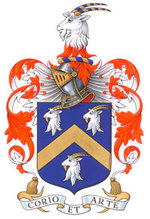 The cordwainer crest Any guesses?..... No? Well, it turns out a “cordwainer” is a shoemaker. The term originated in medieval Cordoba in Spain, a region controlled by Muslims who excelled, among other things, in the production of high-quality specially-tanned leather. (See the goats in the guild crest?) 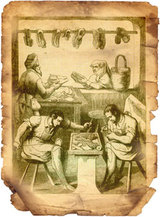 cordwainers at work The French referred to those who made shoes from this leather as cordonnier, which became “cordwainer” in England (you know, after that little Norman invasion of England in 1066). According to the website for the Worshipful Company of Cordwainers--yes, the medieval guild still exists today as a charitable group!—the cordwainer must be distinguished from the cobbler. The cordwainer only worked with new leather, while the cobbler could only work with old. (Indeed, cobblers could get in a lot of trouble if they were found with new leather). 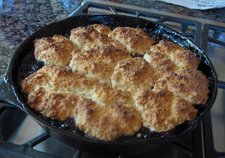 mmm...leatherless cobbler pie And the more important question of all?
What does any of this have to do with blueberry cobbler? (Only that early American settlers used to make pie from any foodstuffs on hand-- cobbling it together as a cobbler would piece together shoes...Maybe Will Smith likes blueberry cobbler too, I don't know.) What do you think? Do you know of any surnames--celebrity or otherwise--that have an interesting history?
7 Comments
Matt
2/22/2012 11:32:44 am
I'm trying to think of British-sounding surnames. Archer, Carter, Carver, Gardner...these seem pretty obvious. Matt--these are great examples of metonymic occupational names. Bailey had to do with a bailiff, I believe. Chapman refers to a merchant (so chapbooks are books for trade), while Chandler refers to a candlemaker. A fletcher was an arrowmaker. I had to look up Leach, and it seems to have disputed origins: It may have referred either to a doctor who came to be called Leach for using leeches in his practice, or perhaps from a topographical place name, coming from loecc or lacu, referring to one who worked or lived near water. 2/23/2012 12:54:34 am
My grandmother's last name was Palmer, a name that apparently was granted to those who fought in the Crusades. My recollection is pretty sketchy, but I believe a palm badge was given to those men as a memento of their service, and only they had the right to be called Palmer.
Cory
2/24/2012 03:44:19 am
I love the names Shoemate and Boatwright and have a minor obsession with names like Braithewaite, Thistlethwaite, and Postlethwaite. Interesting about the names that have jumped over and become first names: Mason, Fletcher, Carter, Cooper .... In my family. there's LeSaulnier, which has to do with salt (perhaps). There was a teacher in my school named Herr Steinschneider (stone cutter), which is a pretty fabulous name. But, more to your point: Dymond (dairyman); Barker (tanner); Chapman (shopkeeper); Clark (cleric or clerk); Campbell (crooked mouth -- only a few make this into a profession, though); and the excellent Walker (cloth fuller). V. interesting about Palmer .... I didn't know that! Cory, I love those names too! Braithewaite, Thistlethewaite, and Postlethwaite seemed to have referred to both the one who cleared the broad area, the thistle, and the farm area, and then became placenames as well--so someone might also have taken the name of their town as well. I think I'm going to add one of these names in the book I'm working on right now--they evoke a lovely lyrical quality. Leave a Reply. |
Susanna CalkinsHistorian. Mystery writer. Researcher. Teacher. Occasional blogger. Categories
All
Archives
May 2023
|
 RSS Feed